Walk the land with Vinay
Learn how ecological restoration actually happens. Not in theory, but in practice: soil, fungi, succession, canopy, water, and what it means to work with the land rather than against it.
Shanti Earth · Nellivarai · Kodaikanal
Morning practice. Forest air. Simple food. Good work. A place to live close to the land for weeks or months, not a long weekend.
Enquire about a stay↓Nellivarai · Kodaikanal · Western Ghats
Walk in, slow down,
and feel the earth.
Shanti Earth is a small farm and forest in the hills of South India. Ten acres of abandoned farm land brought slowly back to life, where a handful of people live by a quieter rhythm, and a few guests come to share it for weeks or months at a time.
What this is
Shanti Earth is not a yoga retreat. It is not a wellness resort. It is not a co-working space hidden in the hills.
It is a living experiment in a different way of being.
Tucked into the mountains outside Prakashpuram in Nellivarai, it is part farm, part forest, part community, part practice space. Daily life turns on simple things: movement, meditation, meaningful work, food from the land, the slow business of restoring an ecosystem, good conversation, rest, and the changing moods of the weather.
People come here for many reasons. Some arrive exhausted. Some are looking for direction. Some want to go deeper into their practice. Others just want to spend time somewhere real. What they find is not a programme but a rhythm.
Come long enough to remember what life feels like when it is not organised around urgency.
No promises. No transformations guaranteed. Just the chance to live differently for a while.
The story of the land
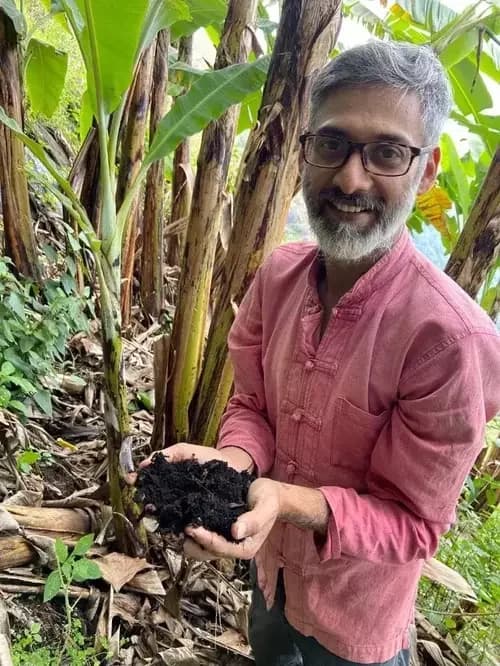
When Vinay first came to this hillside, the land was slowly healing but overgrown with invasive species, trees dying out, and years of chemical farming had left the soil depleted, leading to frequent landslides. For most of a decade since, he and the community around him have been turning it back into a living food forest.
The method is myco-permaculture: working with fungi, the quiet engine of healthy soil, and planting in layers the way a forest does, so the system can begin to feed and water itself. Terraces were shaped by hand, trees went in, water was slowed and held, and slowly the ground came back to life.
When you stay, you arrive in the middle of that story. For a while, you become part of it.
10
acres revived
~10
years of work
5
cottages & cabins
15
guests at most
3
meals a day
365
days growing in abundance
If a month in the hills is starting to sound like something you need, that is enough to begin a conversation.
Enquire about a stay→The land
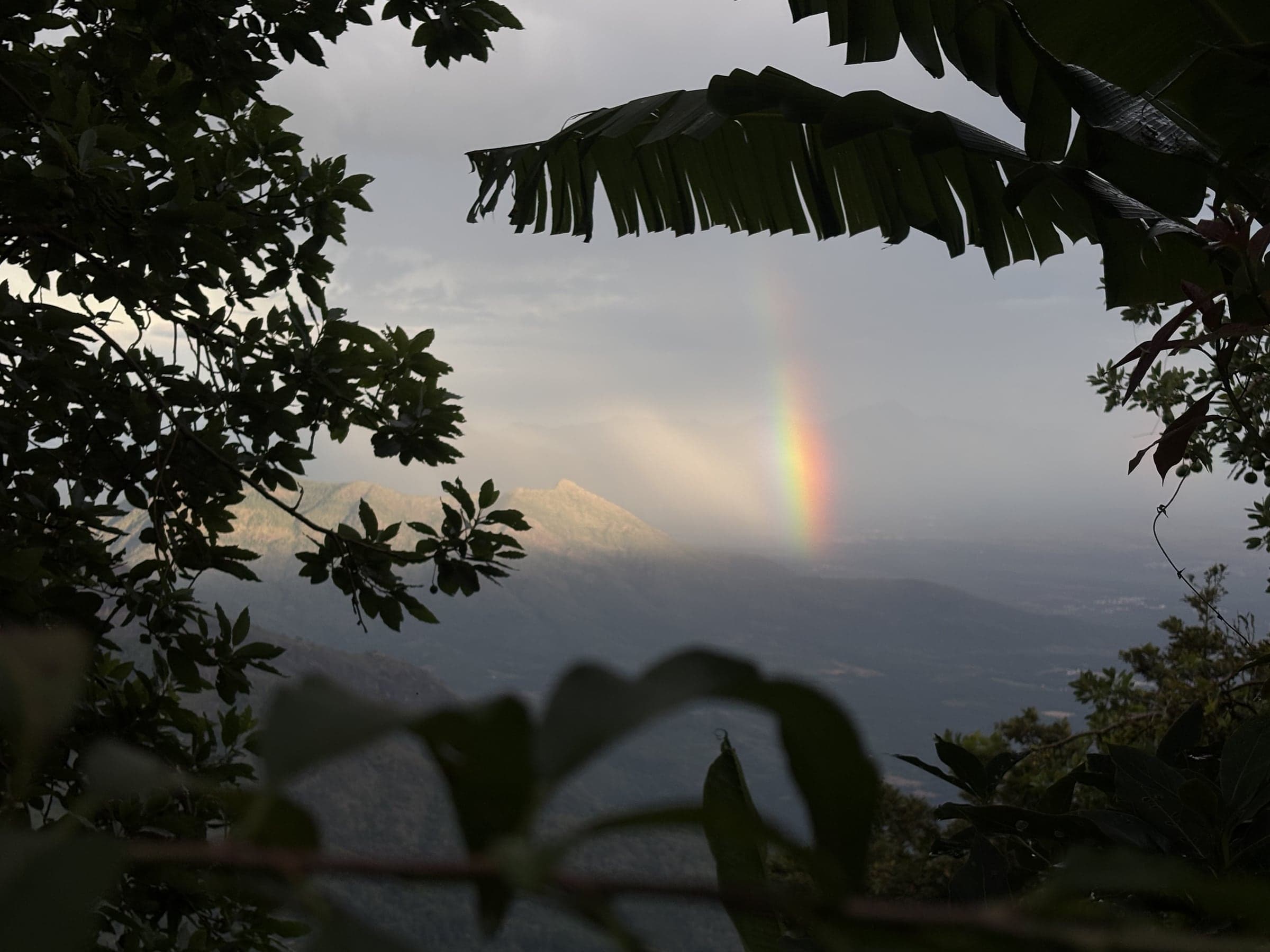
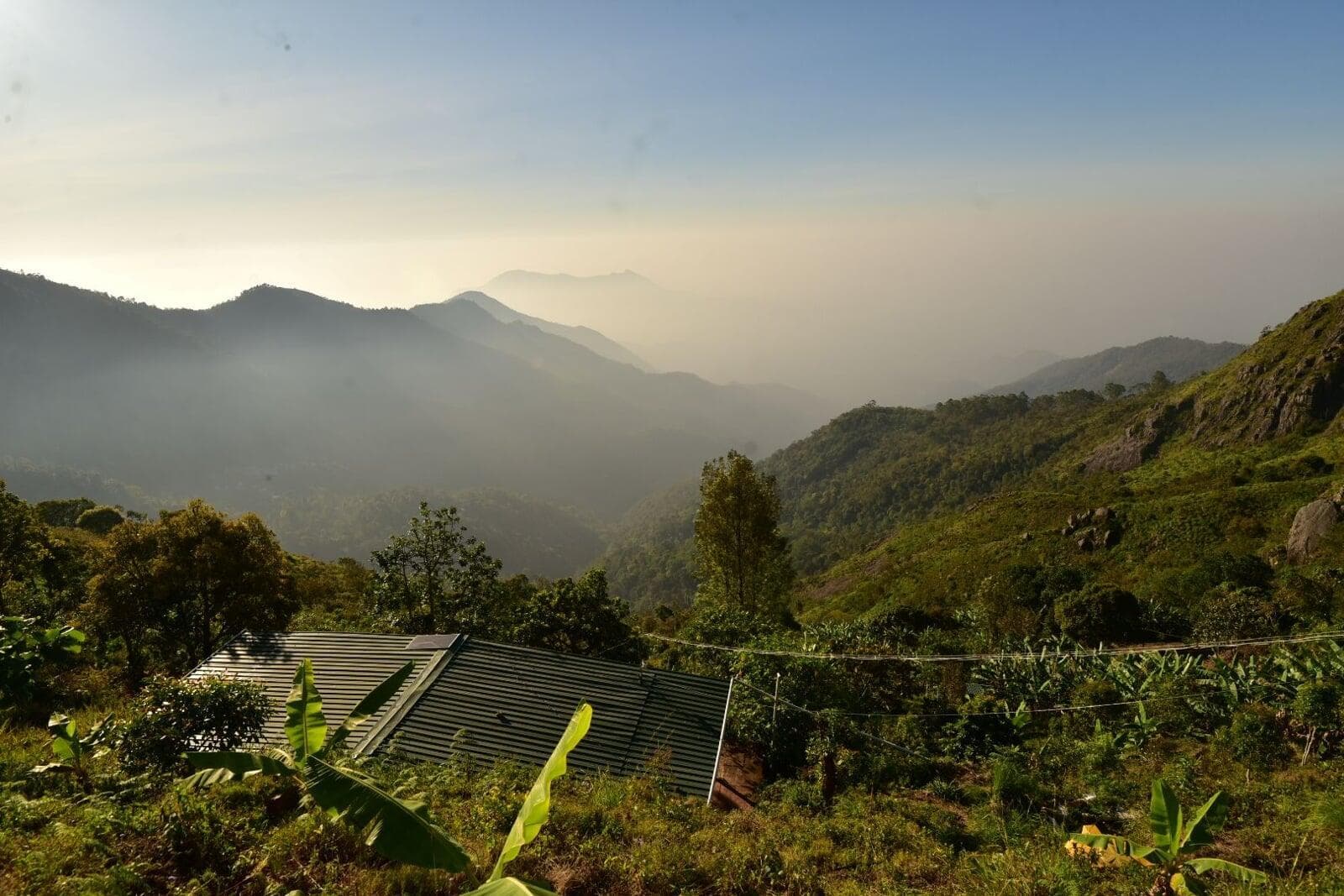
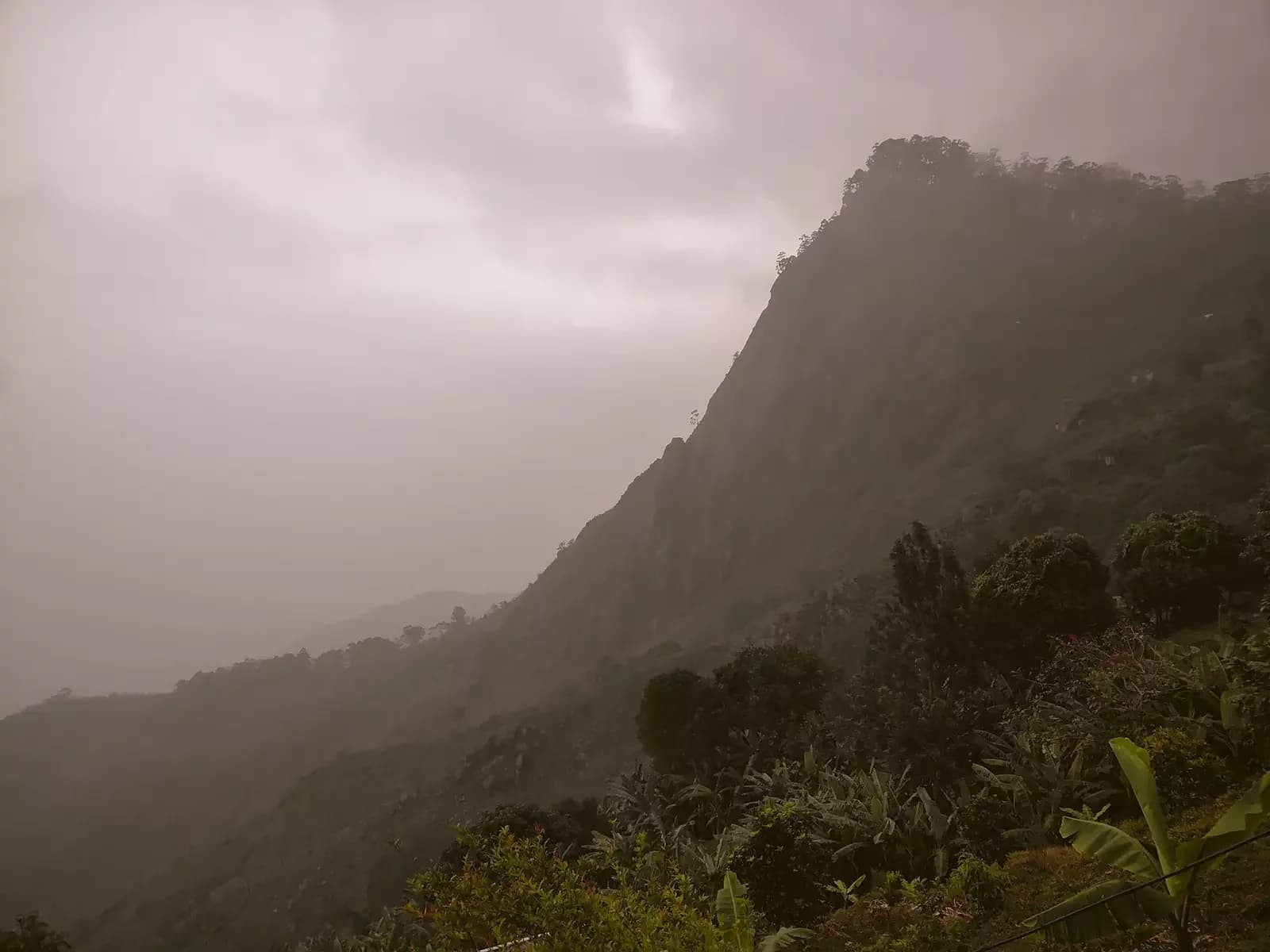
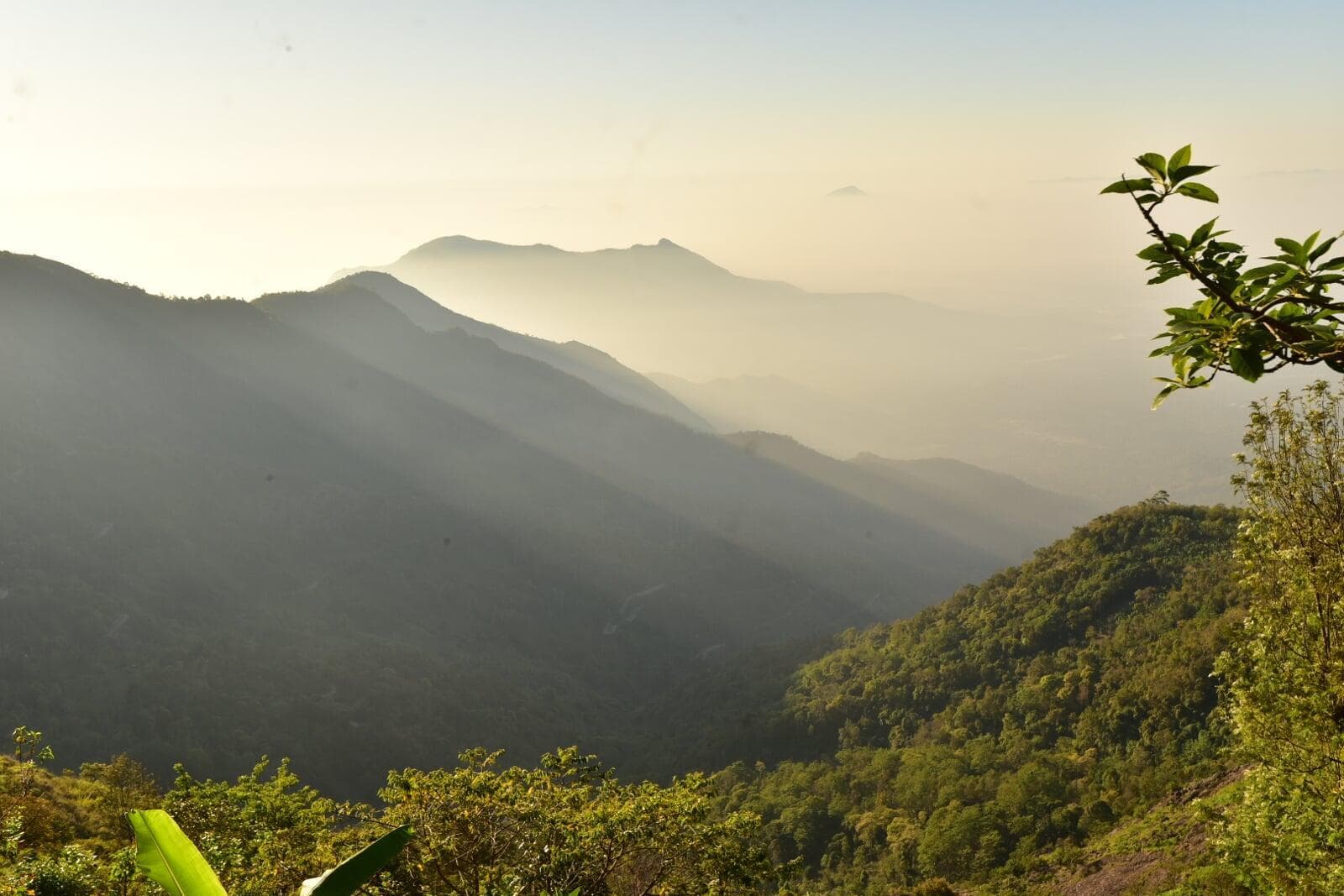
The Western Ghats are among the oldest mountain ranges on Earth. We are in one of the top ten biodiversity hotspots in the world, wrapped in cloud for much of the year.
Mist moves through these hills most mornings. Forests cling to steep slopes. Rain arrives without warning. The seasons are marked less by the calendar than by flowering trees, migrating birds, and mushrooms pushing up from fallen wood.
Step off the veranda and you are inside it: the cloud, the birdsong, the steep green going down to the plains. It is the kind of place that quietly asks you to pay attention.
Not beside it.
Not overlooking it.
Within it.
The surrounding forest holds extraordinary life. Birds call from the canopy. Giant squirrels move through the trees. Beyond the edges of ordinary human attention, it carries on its own ancient life.

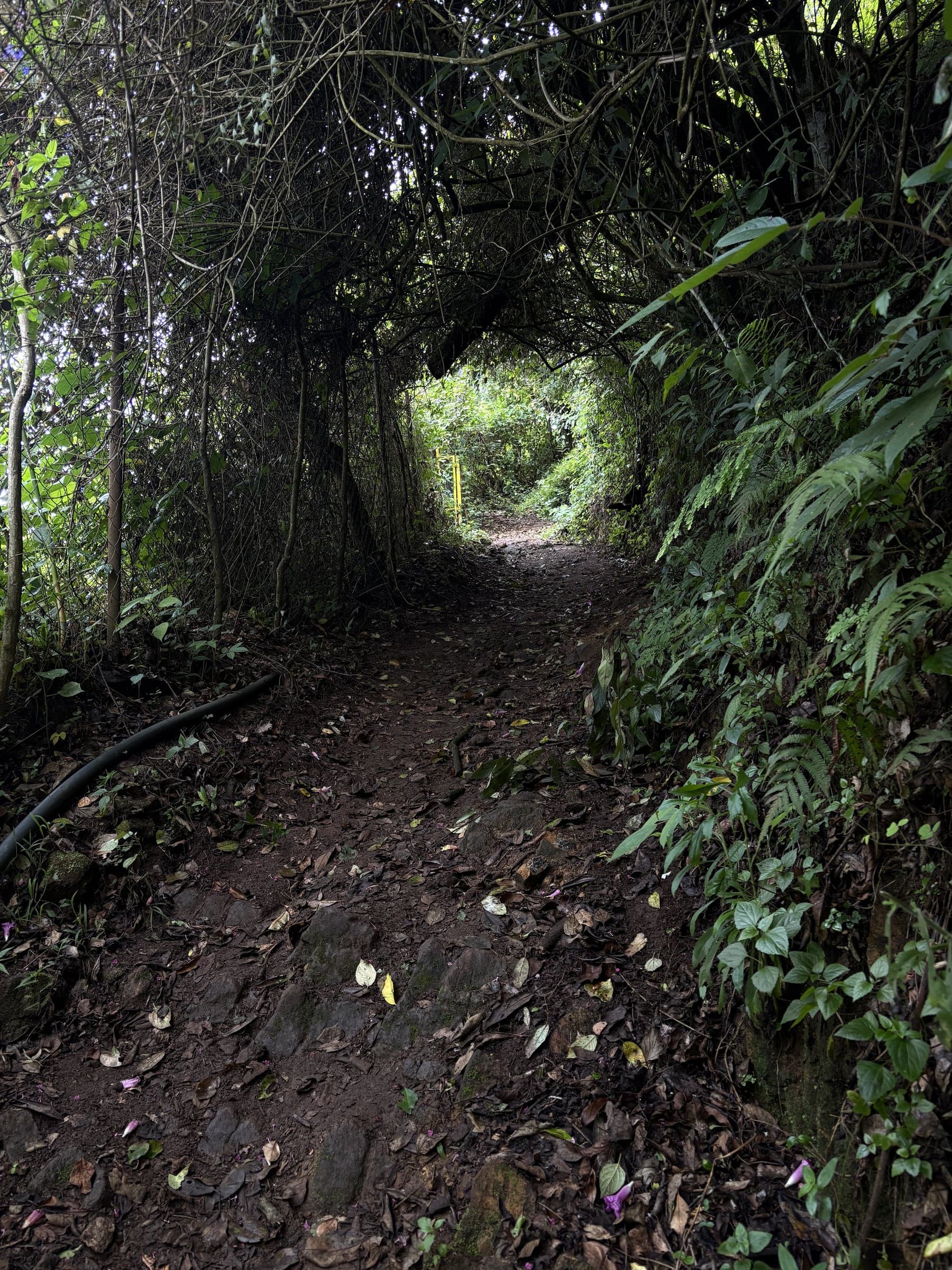
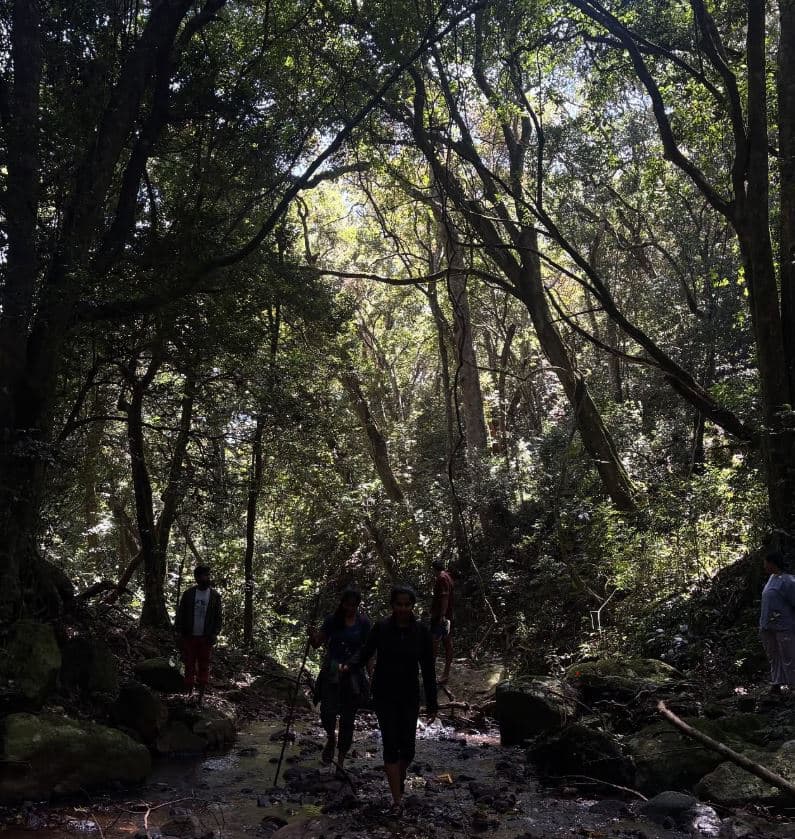
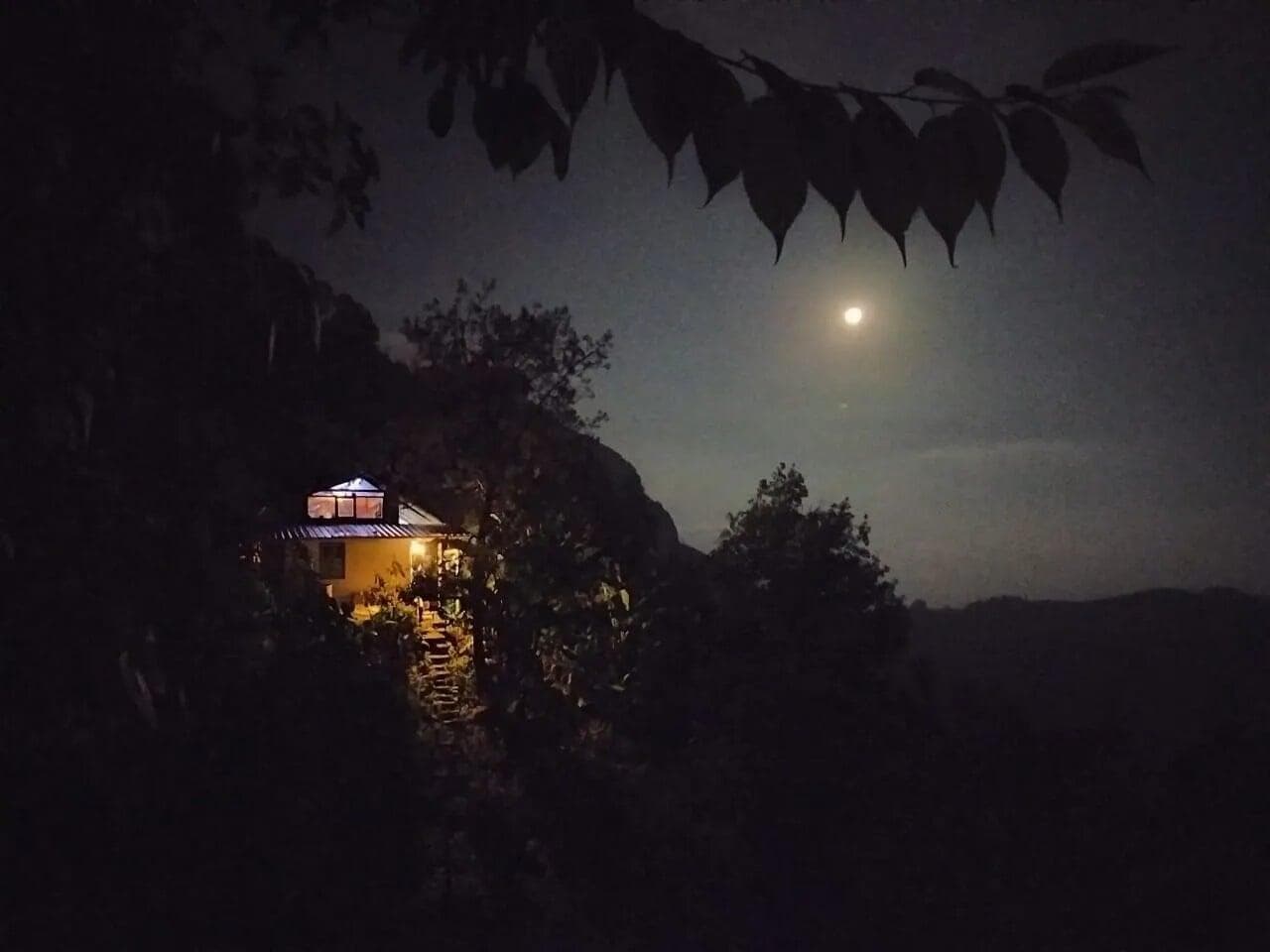
Living here asks something of the body. There are steep paths and stone steps, baskets to carry, trees to plant, soil to move, and daily walks no fitness app would ever design.
There is no gym.
The mountain does a better job.
Guests who stay a while tend to sleep more deeply and move more easily, less from optimising anything than from being out in it all day, and taking part in life again.
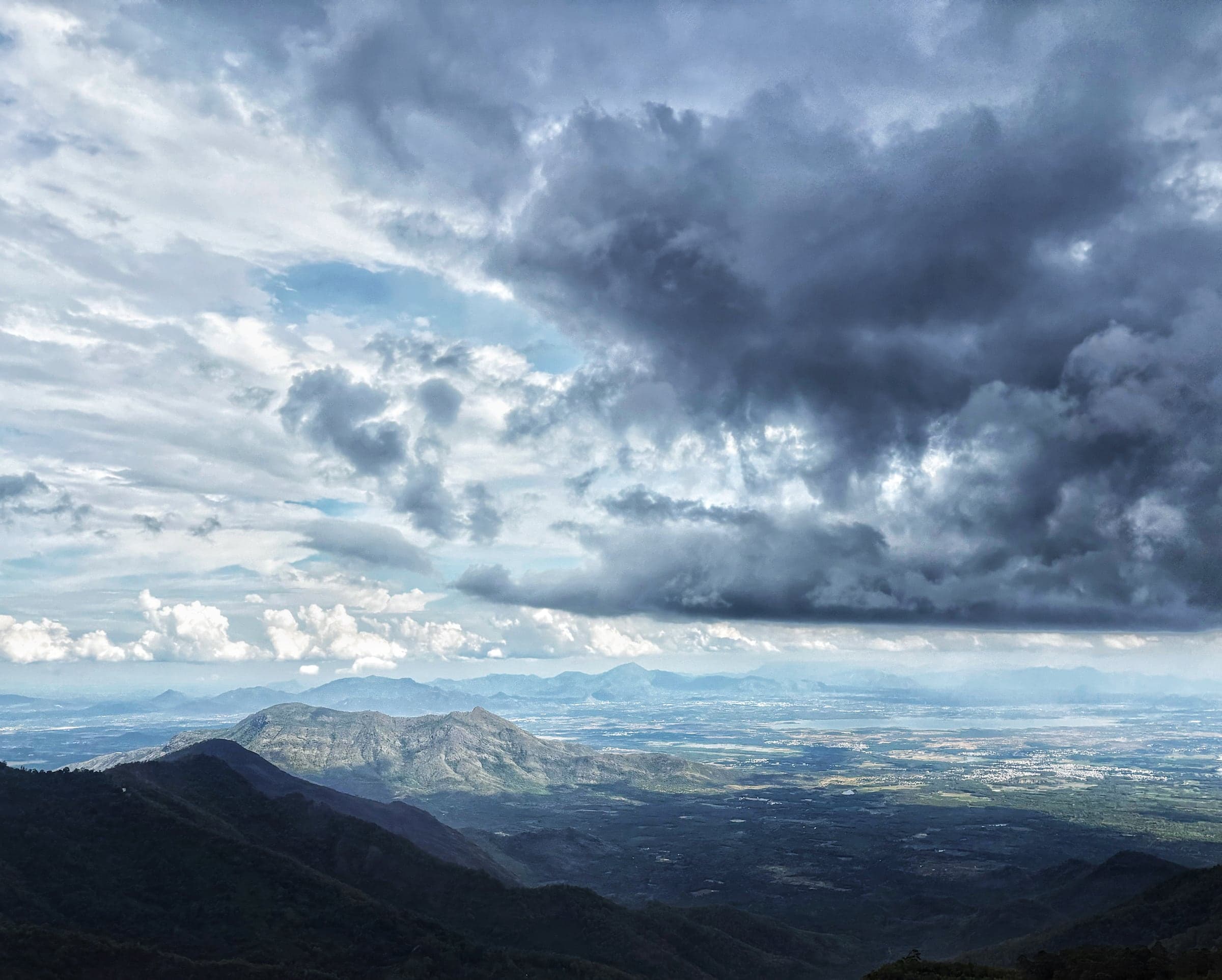
The Western Ghats
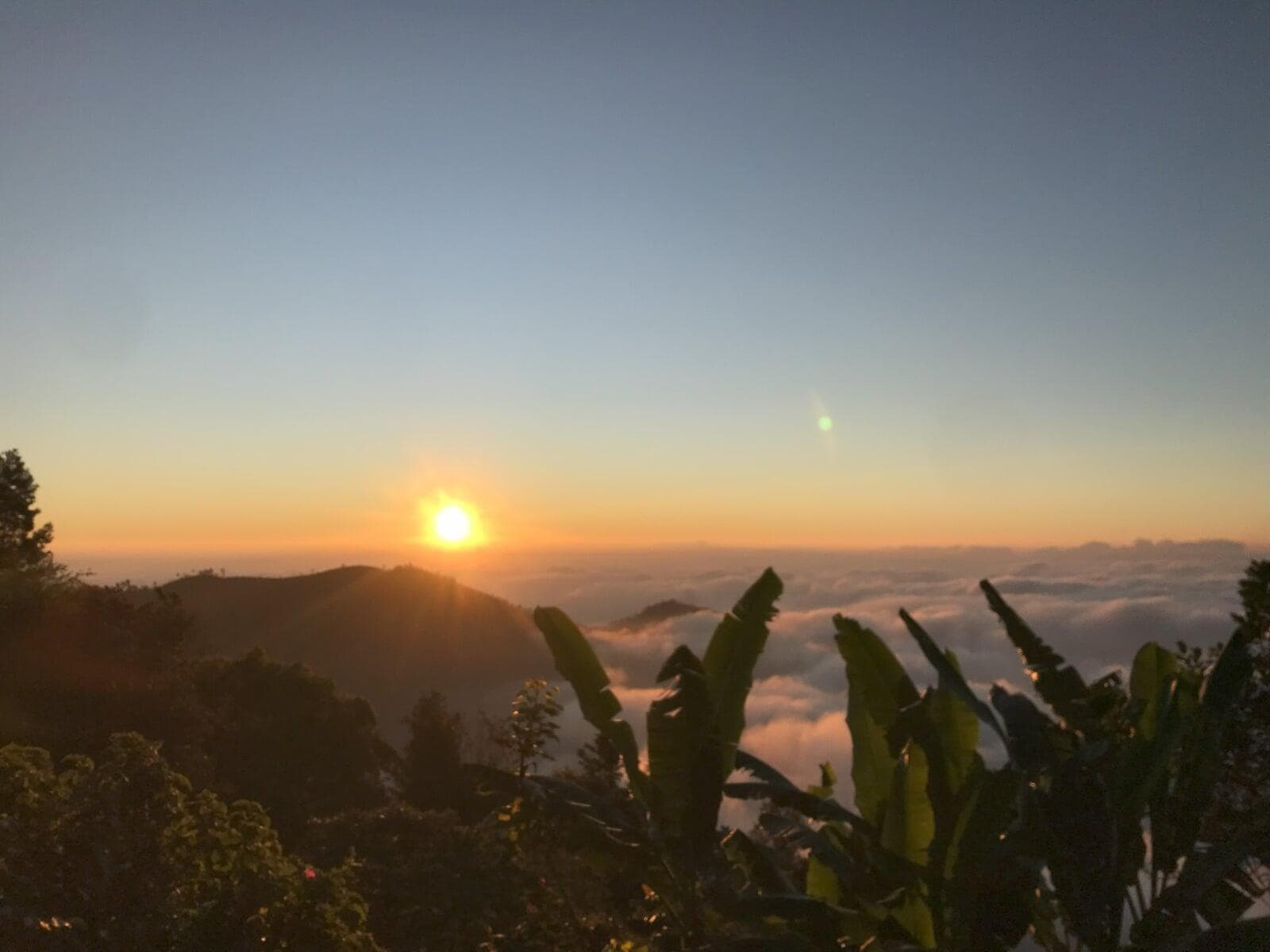
Some mornings the cloud rises out of the plains and fills the whole valley, and for an hour the hills become islands.
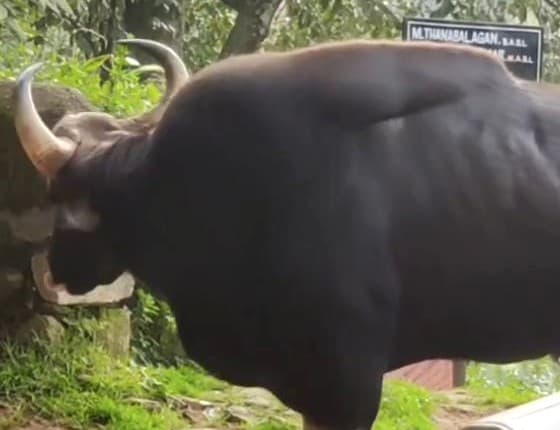
The Indian gaur, the great wild ox of these hills
The forest was here first
Now and then a gaur moves through the trees at the edge of the land: the great wild ox of these mountains, and among the largest wild cattle anywhere on Earth. Dark, unhurried, and entirely unbothered by us, it has a way of rearranging your sense of who the hillside really belongs to.
These animals matter here, not least to the Adivasi peoples who have lived in these forests far longer than any of us and revere the bison as a deity. We keep our distance, keep the nights quiet, and count it a good day when one passes through.
This is their forest. We are the visitors.
Colour, everywhere you look
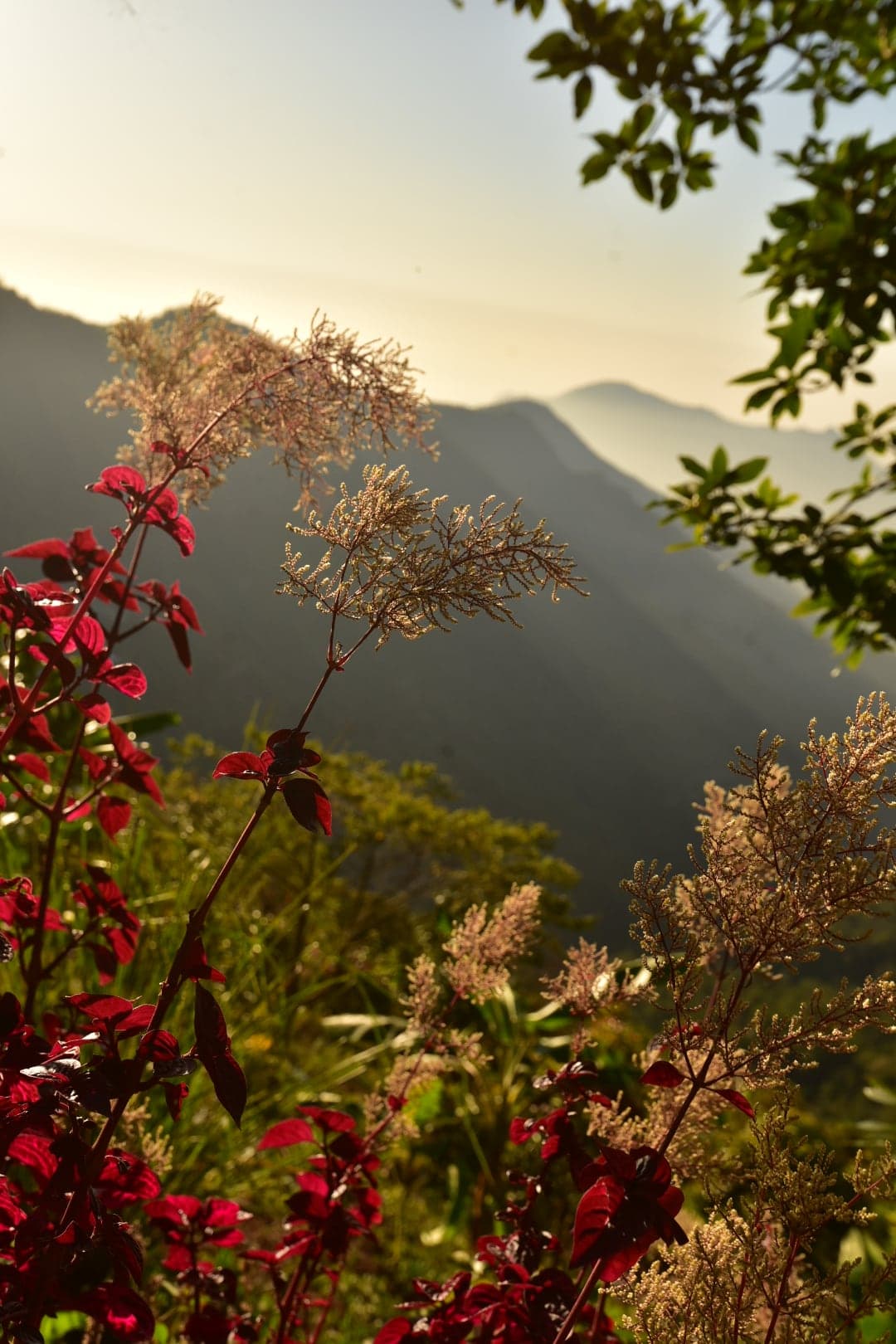
Look closer and the place keeps showing its hand: passion-flowers and wild blossom, turmeric and ginger pulled orange from the soil, strawberries in their short season, chillies and greens for the pot. A corner of the world that has never been shy about colour.

Passion-flower

Fresh turmeric

Hill strawberries
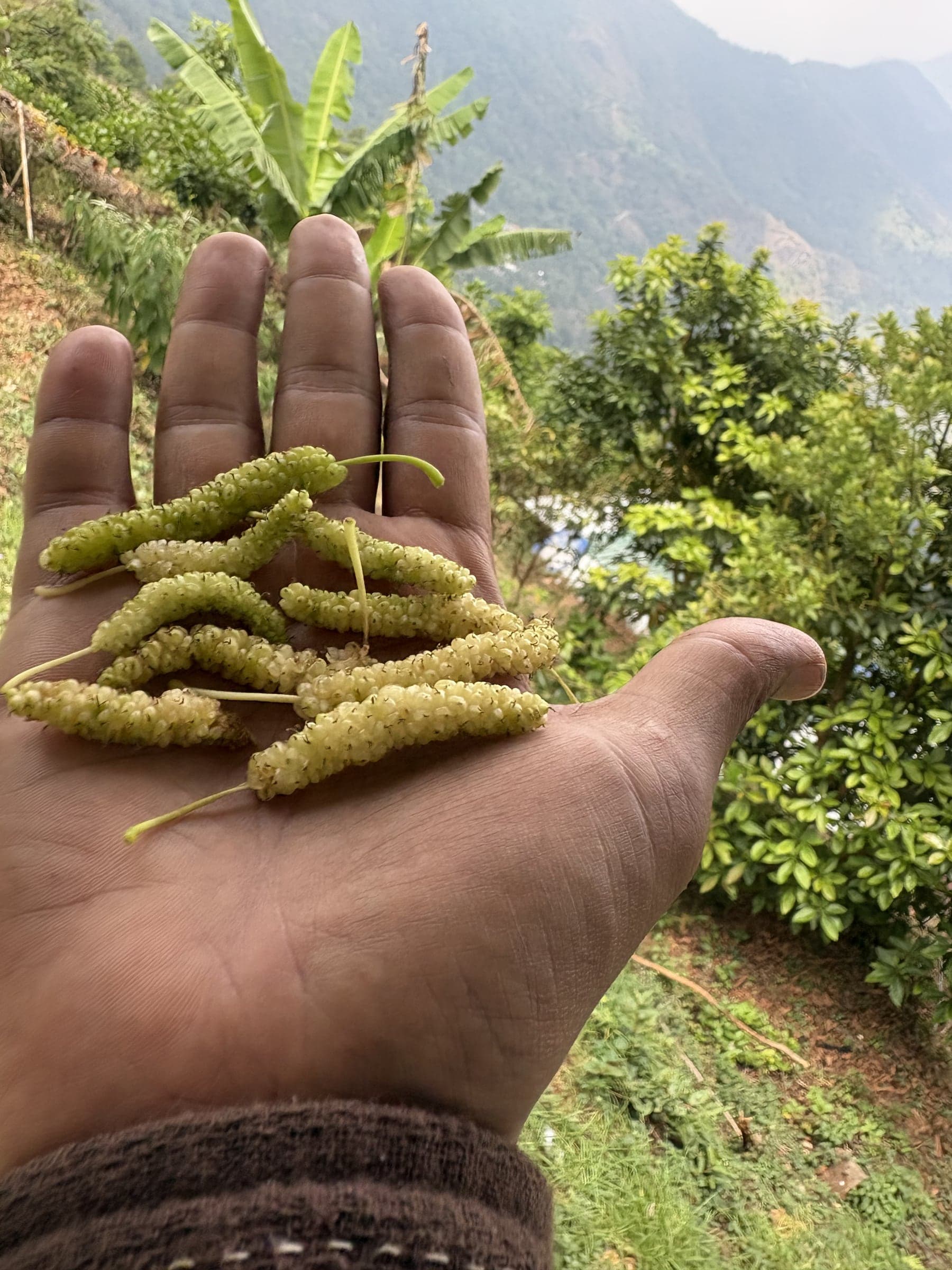
Wild blossom

Straight from the pot
Hill flowers
Tell us your rough dates and we will tell you, honestly, what to expect.
Start a conversation→The rhythm
Not a timetable. A shape.
The slow unhurried rhythm, and the silence you can actually hear.
A guest
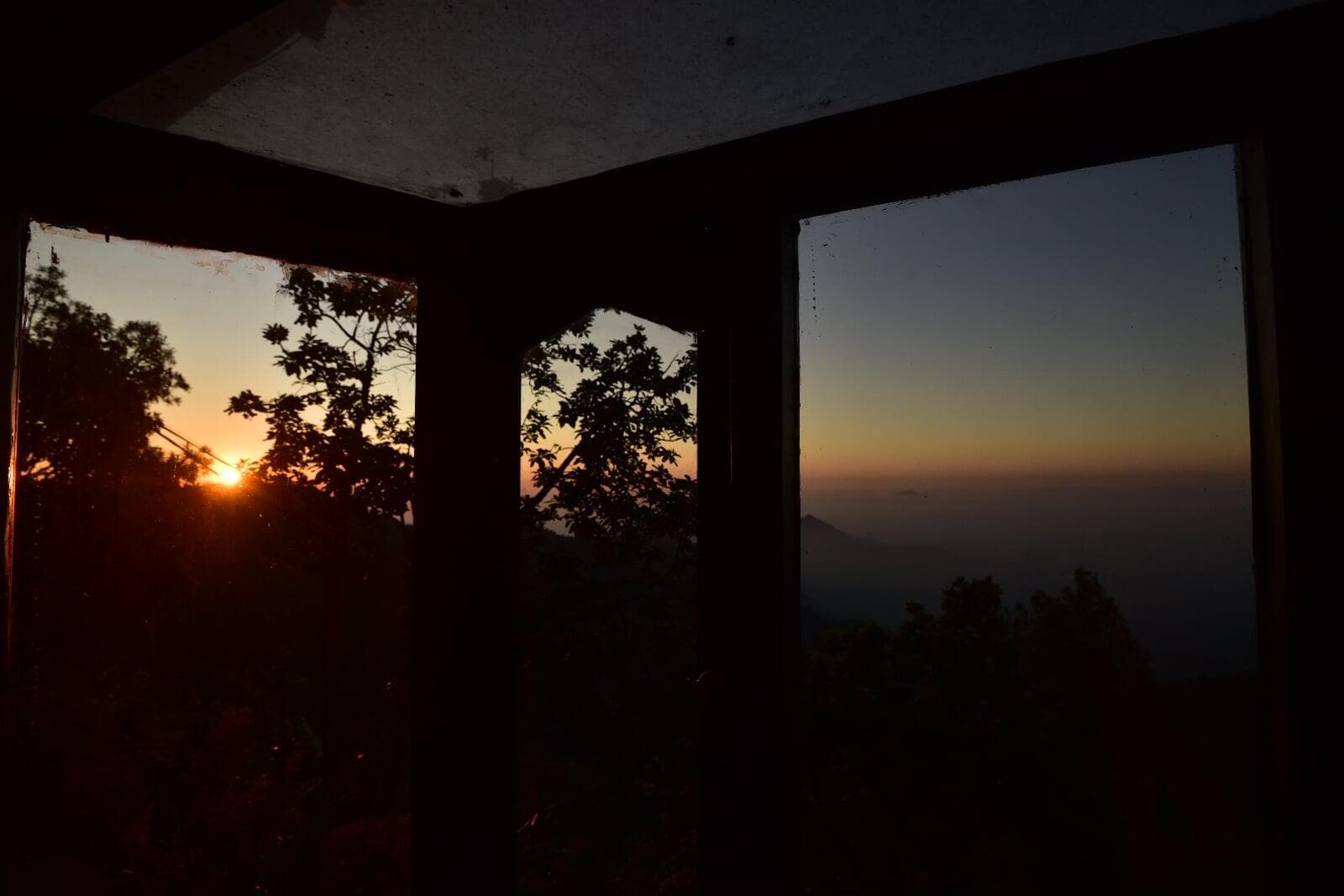
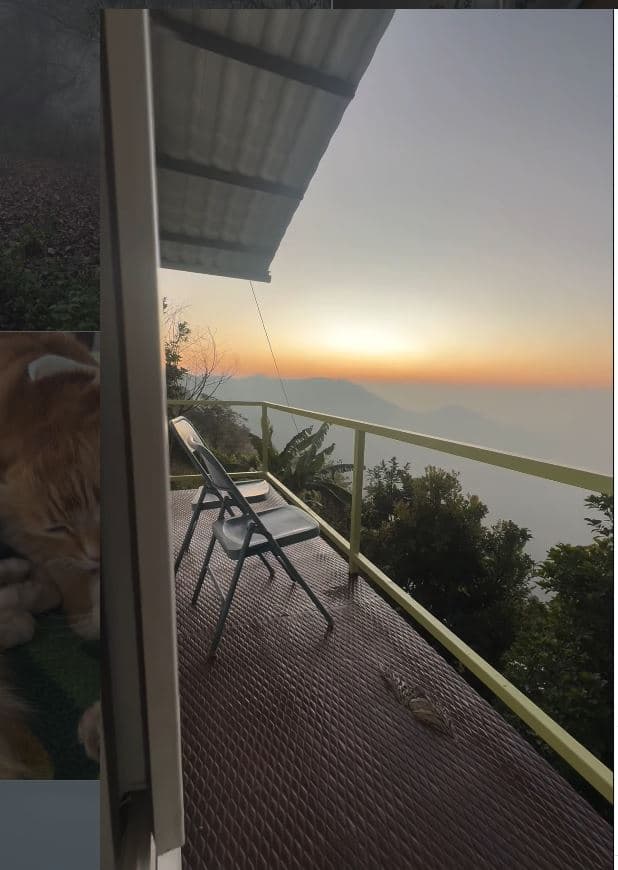
The valley is still in mist. The forest is not yet fully awake. For those who rise early, there is a terrace, a shawl, and the sound of the hills beginning the day.
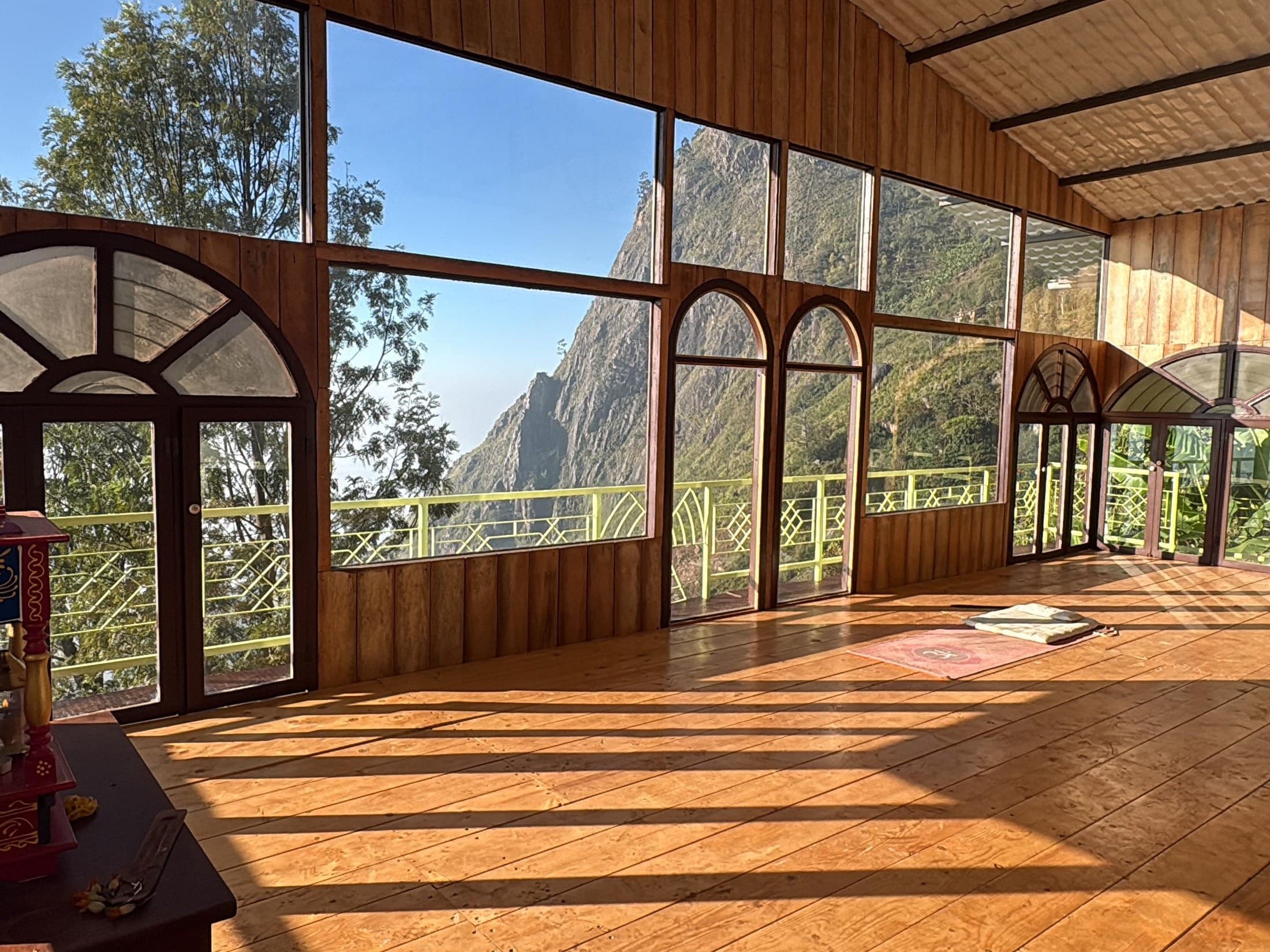
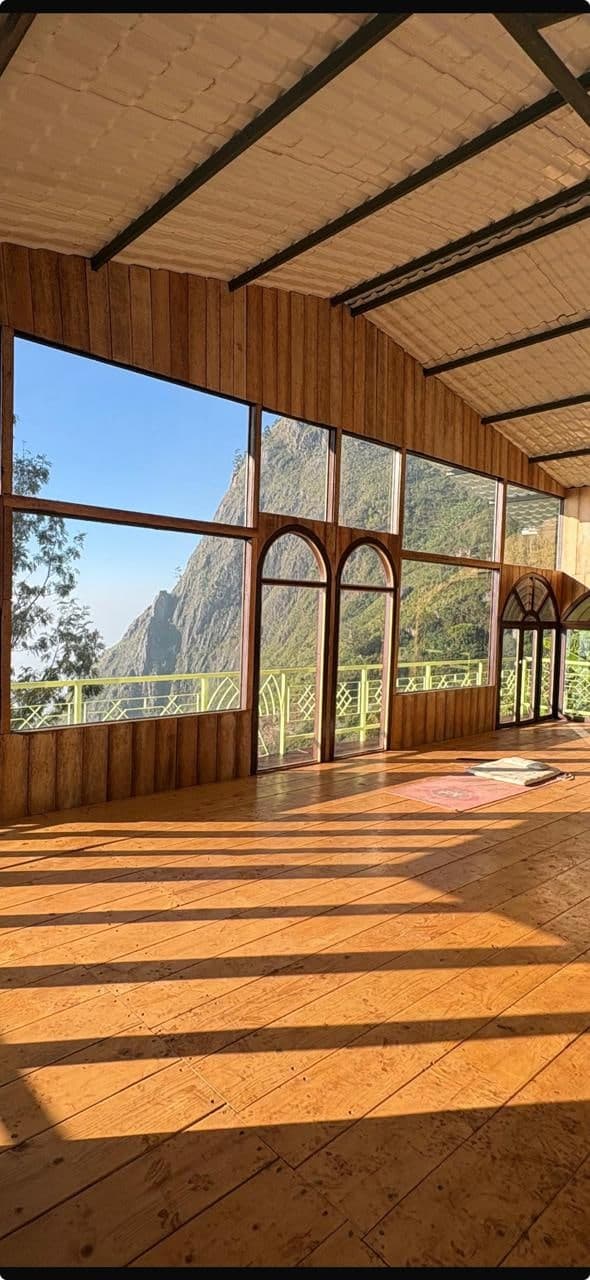
The hall is open, the mats are out, and the hills are in the windows. Yoga, pranayama, meditation, or simply sitting, kept in your own time. When a teacher is in residence the hour is guided instead. No performance, no playlist, no need to be good at anything.
A short community check-in: a little about the day ahead, and a quiet moment for personal reflection or to share.
South Indian, warm, simple, and seasonal, with tea and coffee on the house. Made with what the farm and the local market provide.
Work, write, read, call home, rest, walk, or simply be quiet. WiFi is available. There is no co-working hall, only a room with a view, a shaded corner, a bench under trees.
The midday meal, together at the table. Warm, simple, and seasonal, drawn from the farm and the day's cooking.
Farming, foraging, composting, planting, mushroom work, building, cooking, carrying, learning. You take part in what is actually happening that day, never a performance of it.
The hall opens again as the light goes. Meditation, breathwork, contemplative movement, quiet sitting, or a gentle walk out along the ridge instead. Either way, the day turns inward.
Light, warm, and shared, before the dark comes down over the hills.
The cottage lights glow. The forest thickens around the edges. Stars appear when the mist allows. This is often when the conversations that matter begin.
About the practice hours
The hall is open at both ends of the day, and those times hold whether or not anyone is leading. When a yoga teacher is in residence they become guided classes. When none is, they are yours to keep: self-practice in the hall, or a gentle walk out into the hills, which the hills will repay. Michael, who shaped the practice here, is at Shanti Earth for part of the year rather than all of it. Ask us what is likely for your dates and we will tell you honestly.
Practice
The day at Shanti Earth opens with practice and closes with it. The hall is open at 7:30 and again at 5:30, and those hours are held whether or not there is anyone at the front of the room.
Much of the year, the practice is your own. The space, the mats, and that long view over the hills are simply there: yoga, pranayama, meditation, a slow stretch, a quiet sit. The approach this place was built on is simple and inward. Less about what the body looks like, more about what it feels like to inhabit one with steadiness, attention, and breath.
When a yoga teacher is in residence, those same hours become guided classes drawing on classical yoga, pranayama, and meditation. It happens, and it is lovely when it does, but we would rather say plainly that it is a season and not a promise. Come for the place, and let the teaching be a bonus.
You do not need to arrive flexible, advanced, spiritual, or impressive. You do not even need a practice. Plenty of guests spend those two hours walking instead, out along the ridge and into the forest, and come back having done something just as good for them.
Evening is quieter still. Some sit. Some breathe. Some move slowly. Some take the path down through the trees while the valley cools and the light turns amber, which is its own kind of practice.
Michael, who shaped the practice here, is at Shanti Earth for part of the year rather than all of it. When he is in residence he leads the hall, and offers individual wellness counselling sessions for those moving through transition, grief, burnout, integration, or inquiry, charged separately. They are not a replacement for therapy or medical care, but they can hold a grounded space for honest reflection.
Ecological restoration
Shanti Earth is not a finished retreat centre. It is an ongoing act of restoration.
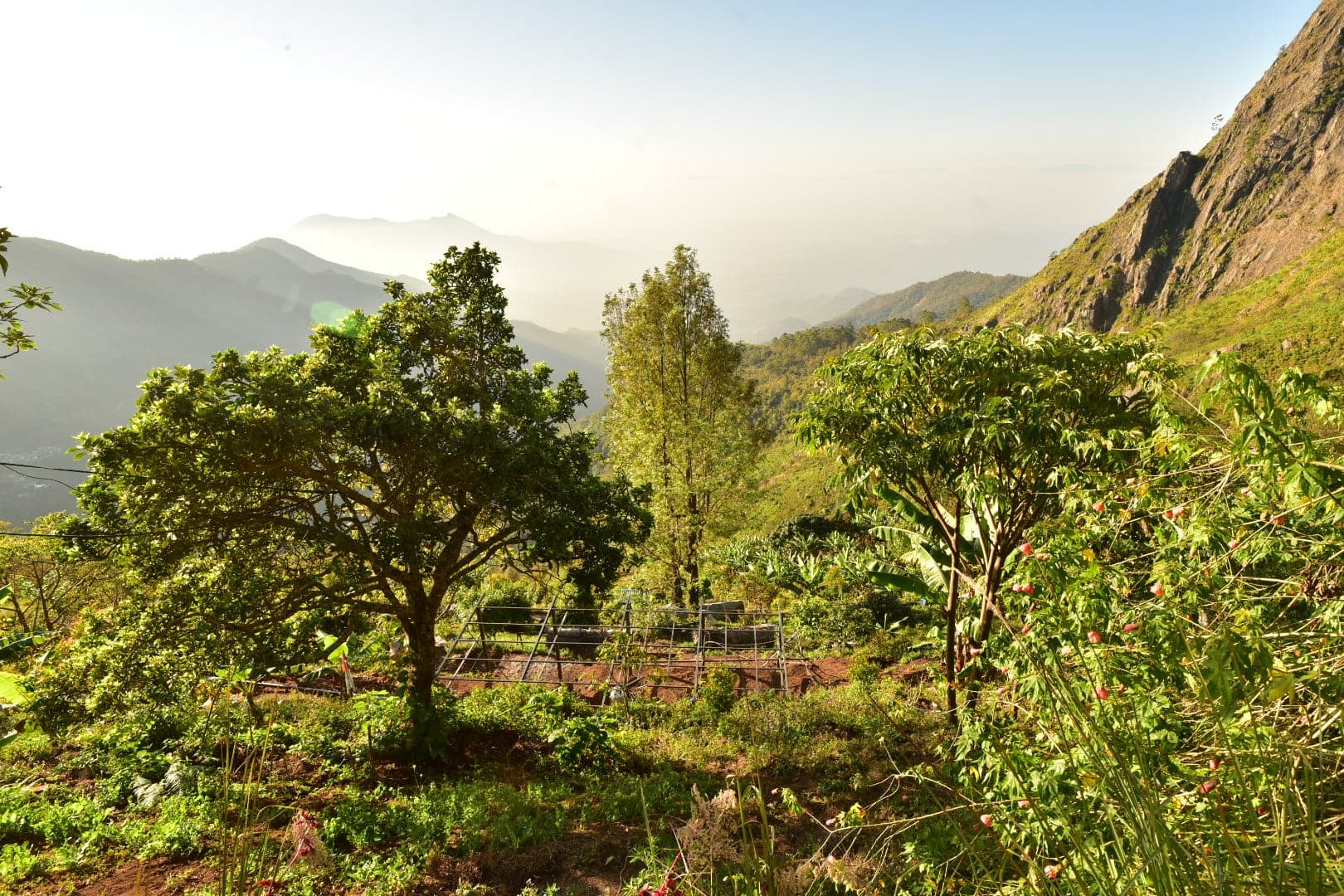
Over the past decade, Vinay and the community around him have been turning abandoned, chemically damaged land into a young food forest and ecological sanctuary, through myco-permaculture, agroforestry, water conservation, and patient daily work.
Every tree has a story. Every terrace was built by hand. Every mushroom bed, pathway, and harvest is part of a larger process still unfolding. Guests arrive in the middle of that story.
Learn how ecological restoration actually happens. Not in theory, but in practice: soil, fungi, succession, canopy, water, and what it means to work with the land rather than against it.
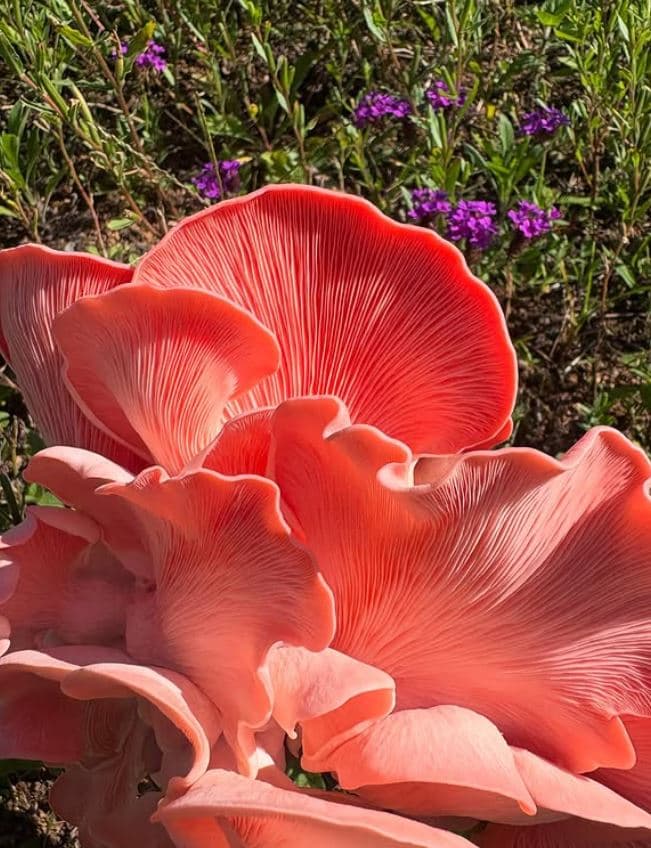
The kindness of mother earth sits at the heart of Vinay's approach to restoration, along with patience, hard work, surrender, and the quiet, remarkable role fungi play in bringing land back to life.
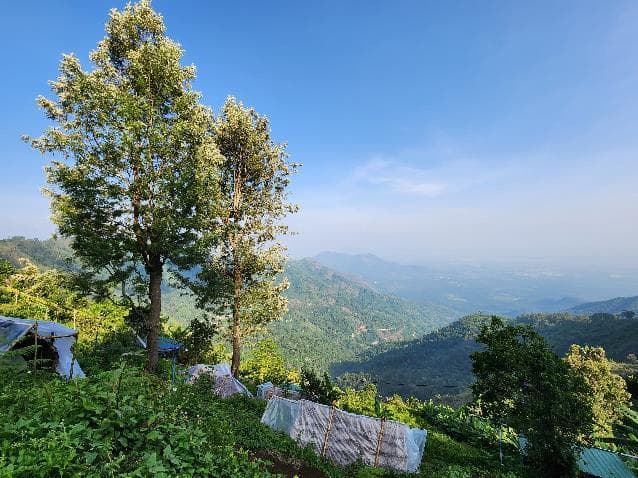
A food forest grows in layers, each doing a job. Compost turned, mulch laid down, water slowed and held on the contour, young trees tended through their first dry months.
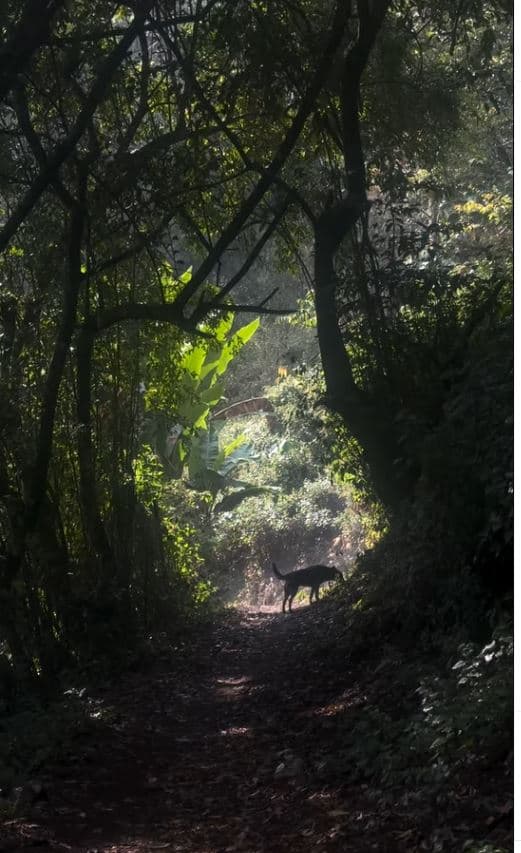
Learn to pay attention. What grows here, what nourishes, what is best left untouched. The forest rewards curiosity and humility in equal measure.
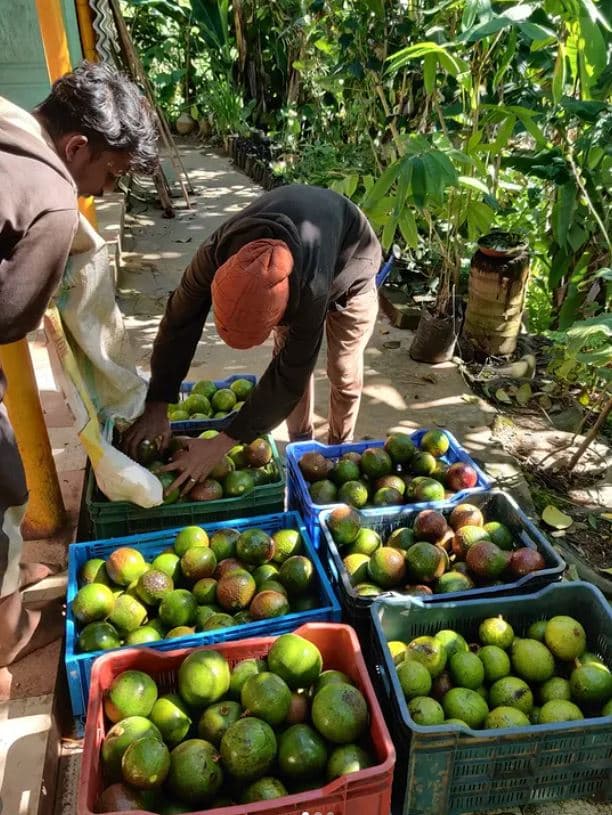
Planting, mulching, composting, harvesting, carrying, repairing, tending. Nothing glamorous, everything meaningful. Karma yoga as it is understood here: caring for something larger than yourself.
The kitchen and the table
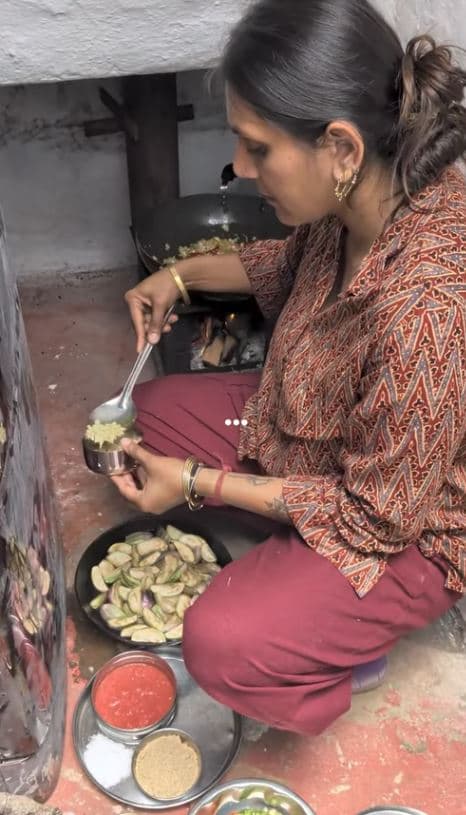
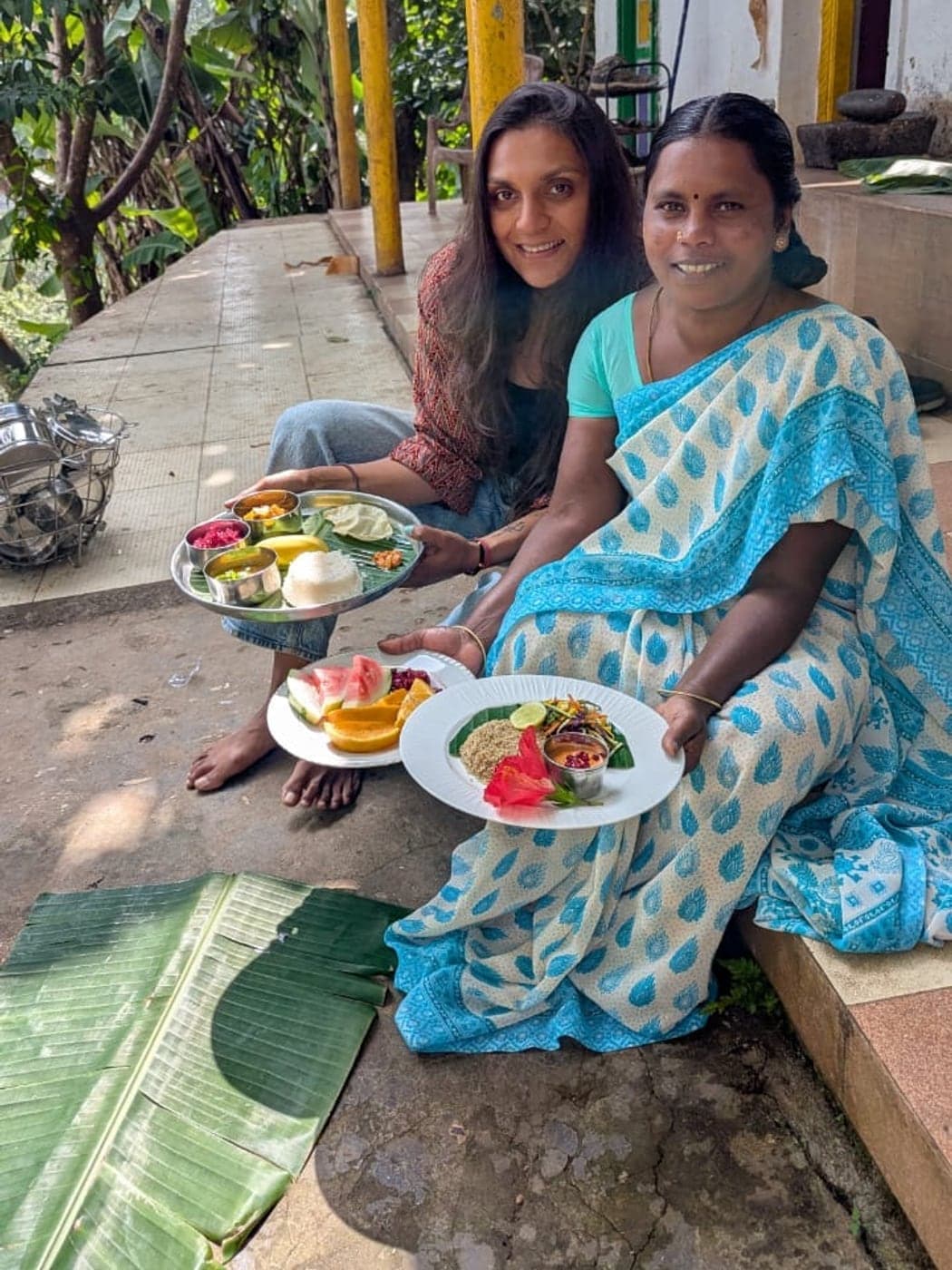
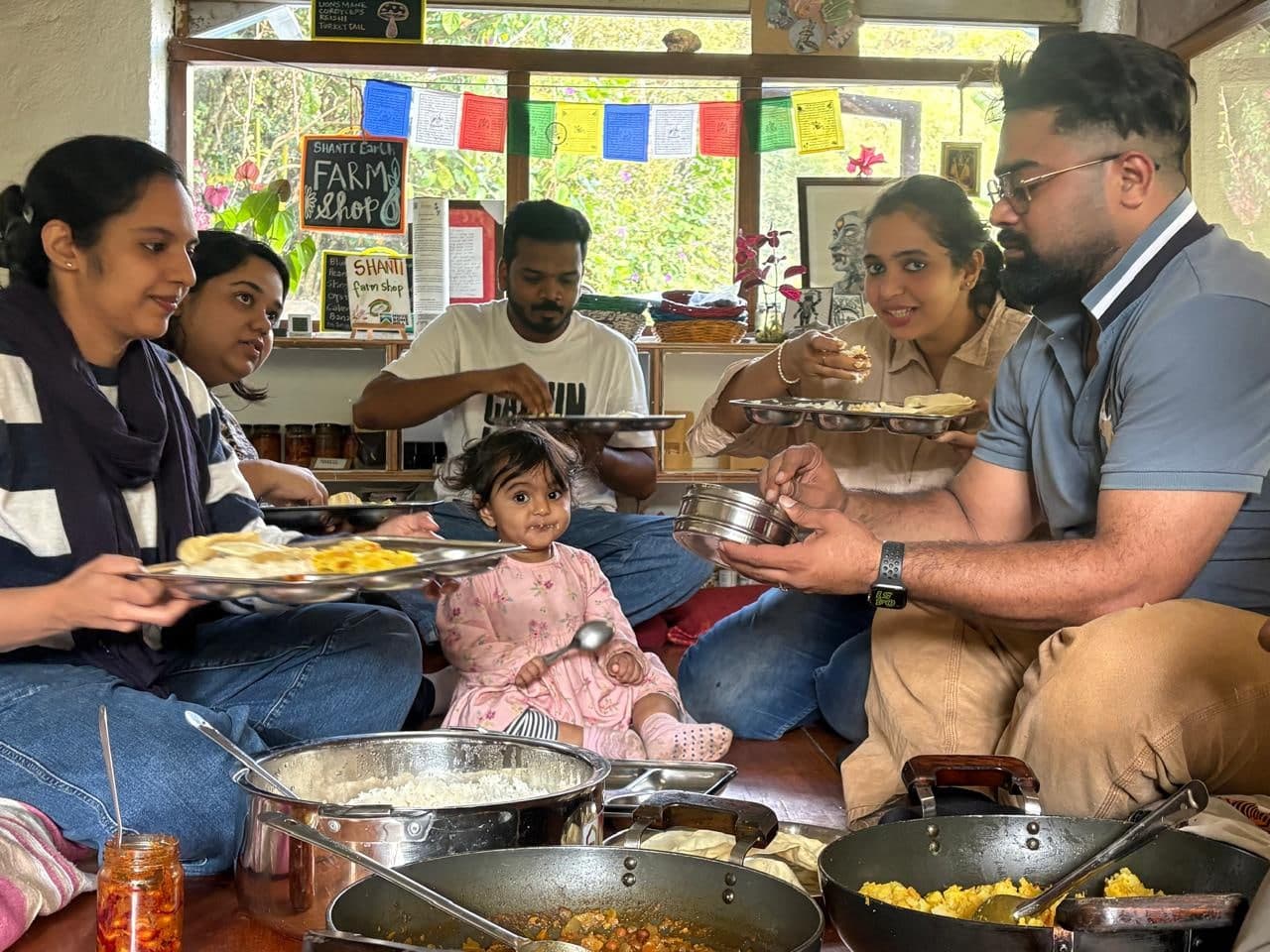
Most days, everyone eats together. Three simple, village-style South Indian vegetarian meals, cooked over wood and flame by Rani Akka and Nikhita, and carried to the communal table at Sakshi, the house at the heart of the day's gathering.
Dosai and idli at their best, podis ground fresh, pickles and ferments put up in season, and whatever the farm is giving that week. Tea and coffee are on the house at breakfast, and the kettle is rarely cold.
Sit near the kitchen a while and you pick up things no recipe holds: how to judge a tempering by its sound, which leaf to add and when, why the simplest plate can be the most nourishing.
From the kitchen
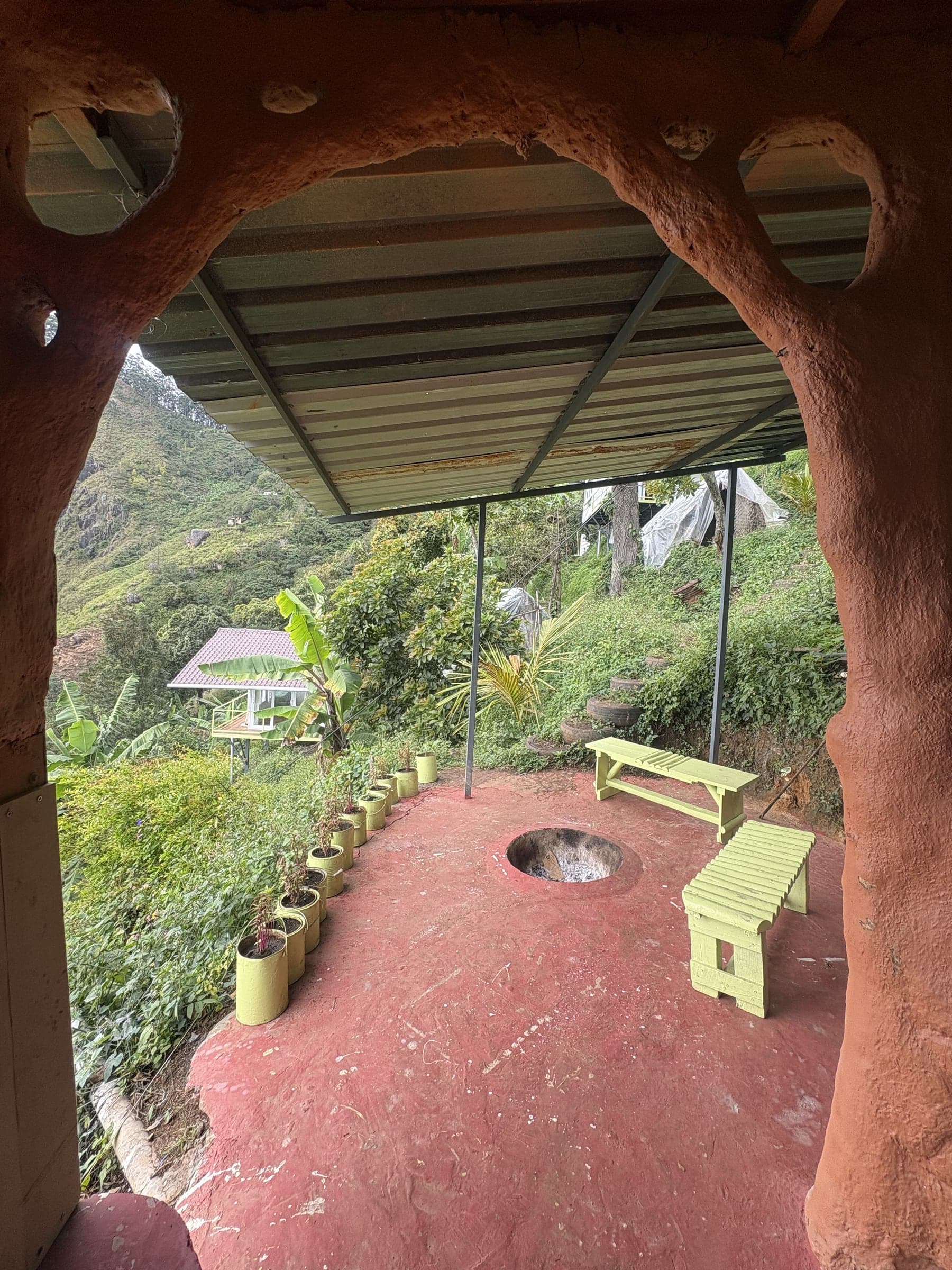
The table looks out over the whole valley.
Mornings of practice, long afternoons on the land, meals at the communal table, and a great deal of nature.
Enquire about a stay→The people
Places matter, but they are also shaped by the people who care for them. The forests, paths, cottages, gardens, and kitchens of Shanti Earth exist because a small group keep showing up, day after day, year after year. You are not arriving at a retreat run by a company. You are arriving in a living community.
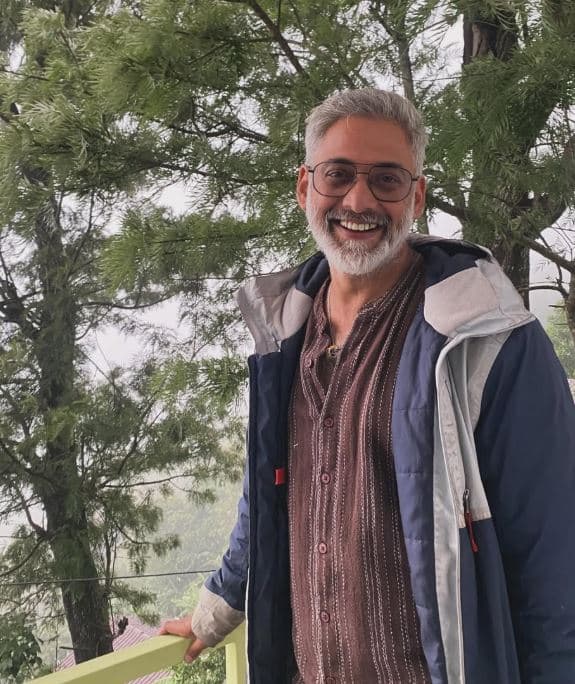
Founder · Land Steward · Host
Long before Shanti Earth was a place others could visit, a version of Vinay arrived who was struggling with the inconsistencies of modern life, looking for something real and meaningful to dedicate his life towards. It was the raw and untamed forest that inspired him to look within for a way to live that nourishes the self, the community, and the broader ecosystem of life on the planet.
His path ran through engineering, photography, farming, ecological restoration, and years of patient experiment with myco-permaculture. Nearly everything guests meet today exists because of that question and the work that followed it.
The trees that now give shade were planted when there was little shade to be found. The pathways were once overgrown. The soil itself tells a different story than it did a decade ago.
He remains both steward and student of the land, as ready to talk fungi at dawn as to sit quietly at dusk. People who spend time with him tend to leave thinking a little differently about how a life might be lived.
Come live and get inspired to create an oasis out of yourself wherever you decide to grow roots. Let this be a reminder that the determination of even a single person can make a positive impact in their lifetime.
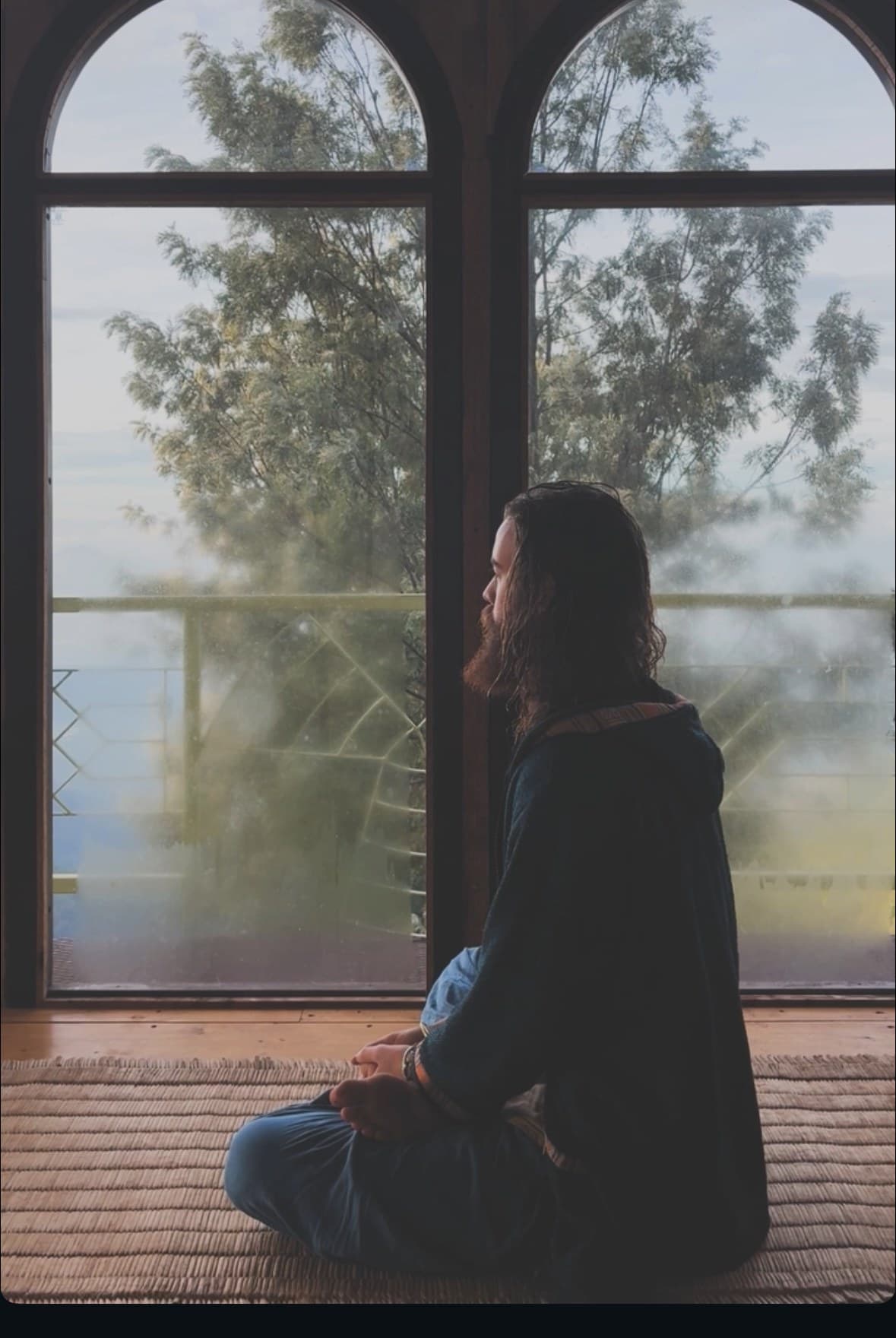
Swami Ramarishi
Yoga · Pranayama · Meditation · Counselling · Here part of the year
Michael came to this work from South Africa, by way of psychology, long practice, and a good deal of time spent in silence. He has held space for others for more than twelve years, much of it trained in India, in retreat and in study. He shaped the morning and evening practice that still gives the day its shape here, and when he is in residence he leads the hall and holds quiet one-to-one conversations for those who want them. He is at Shanti Earth for part of the year rather than all of it, so do ask before you count on finding him. He is steady company for anyone moving through a tender stretch of life, and clear that his job is not to hand over answers, only to help you ask better questions.
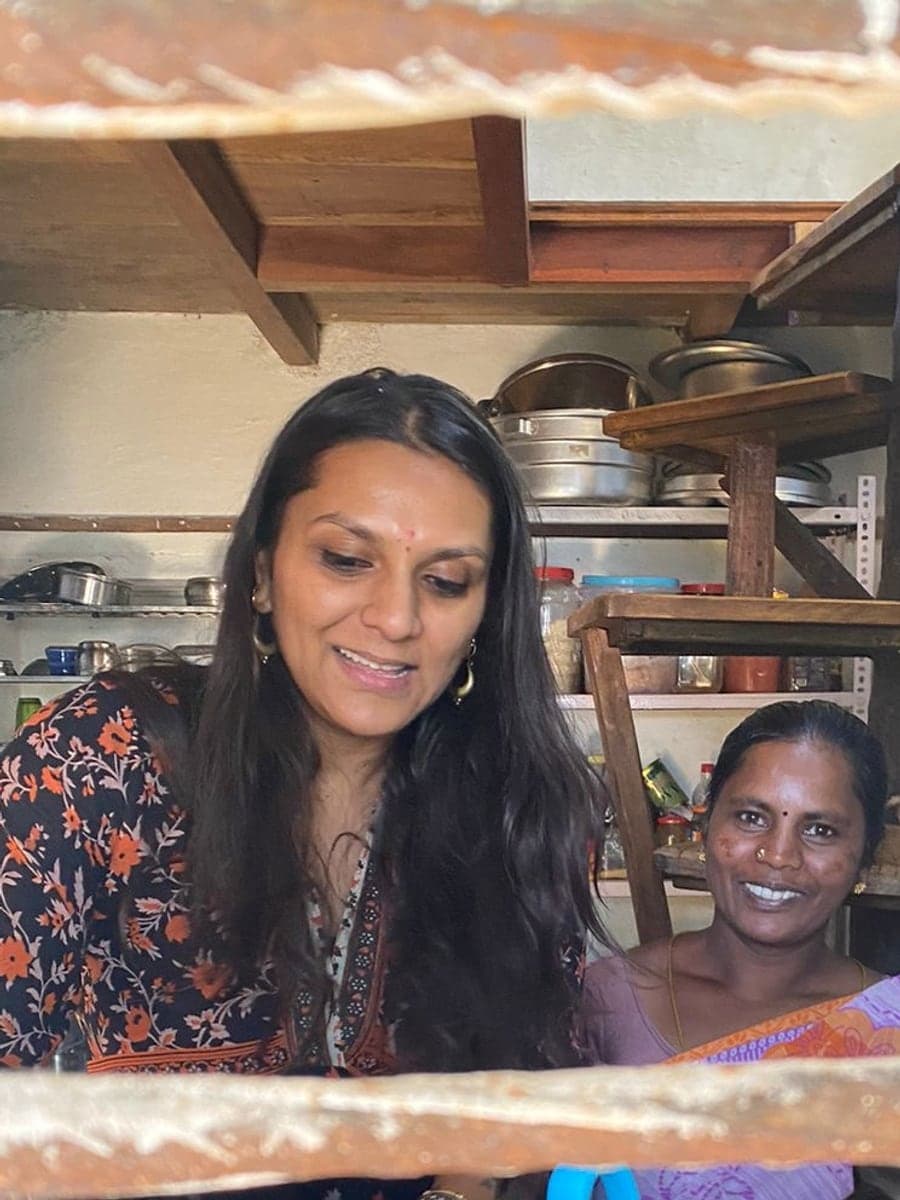
Kitchen · Nourishment · Hospitality
Nikhita Leela is the heart of the Shanti Earth kitchen and our unofficial Chief Officer of Good Vibes. She lovingly nourishes the community with wholesome, seasonal meals while creating a warm, welcoming atmosphere that makes every guest feel at home. Whether she's preparing food, sharing a smile, or making sure everyone is cared for, Nikhita brings the quiet magic of hospitality to daily life at Shanti Earth.
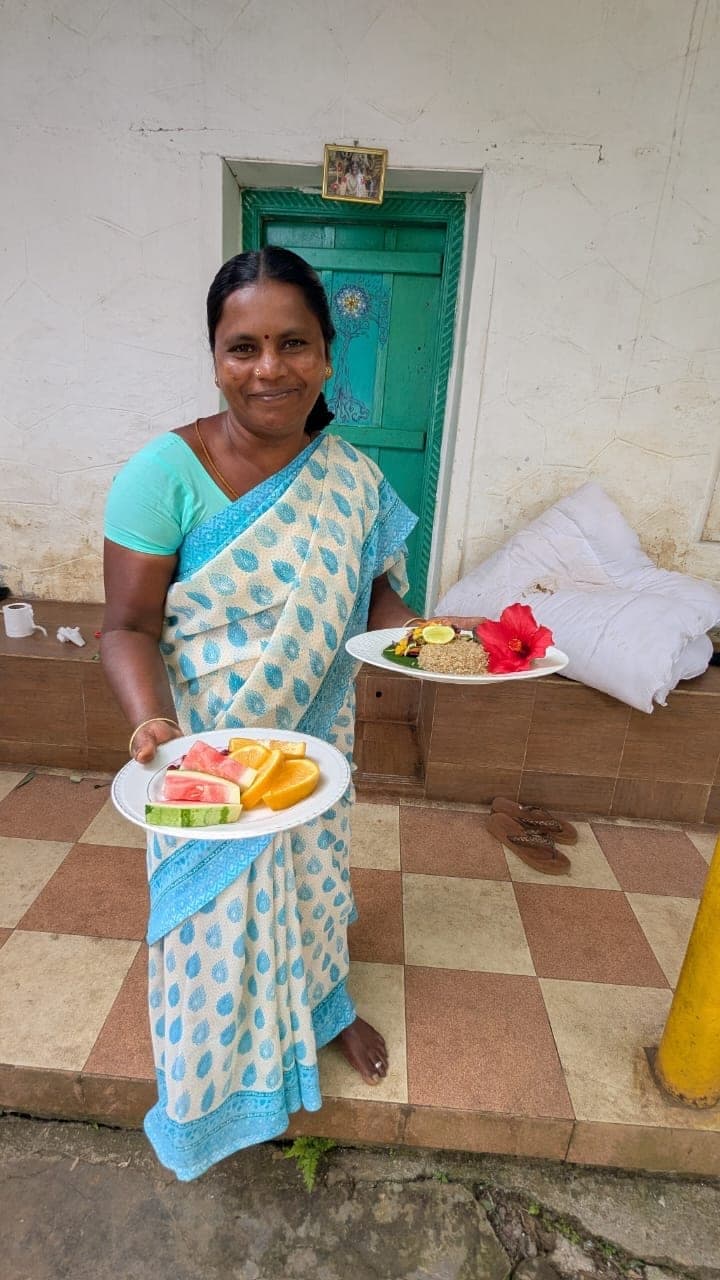
Traditional South Indian Cooking
Akka means elder sister, and for many who pass through Shanti Earth, that is exactly who Rani Akka becomes. She has been part of this place almost since its beginning, carrying the rhythms, recipes, and the wisdom of a lifetime spent cooking with local ingredients and traditional methods. Her dosai and idli have become favourites among guests, but what people remember most is the care with which everything is prepared. Spend an afternoon beside her in the kitchen, and you will come away with more than a recipe.
And everyone else
Beyond the few who hold the place are the people who pass through and stay a while: long-term guests, friends, the occasional volunteer. Evenings tend to gather of their own accord, around shared food and unhurried talk. And the animals, it must be said, consider the whole hillside theirs.
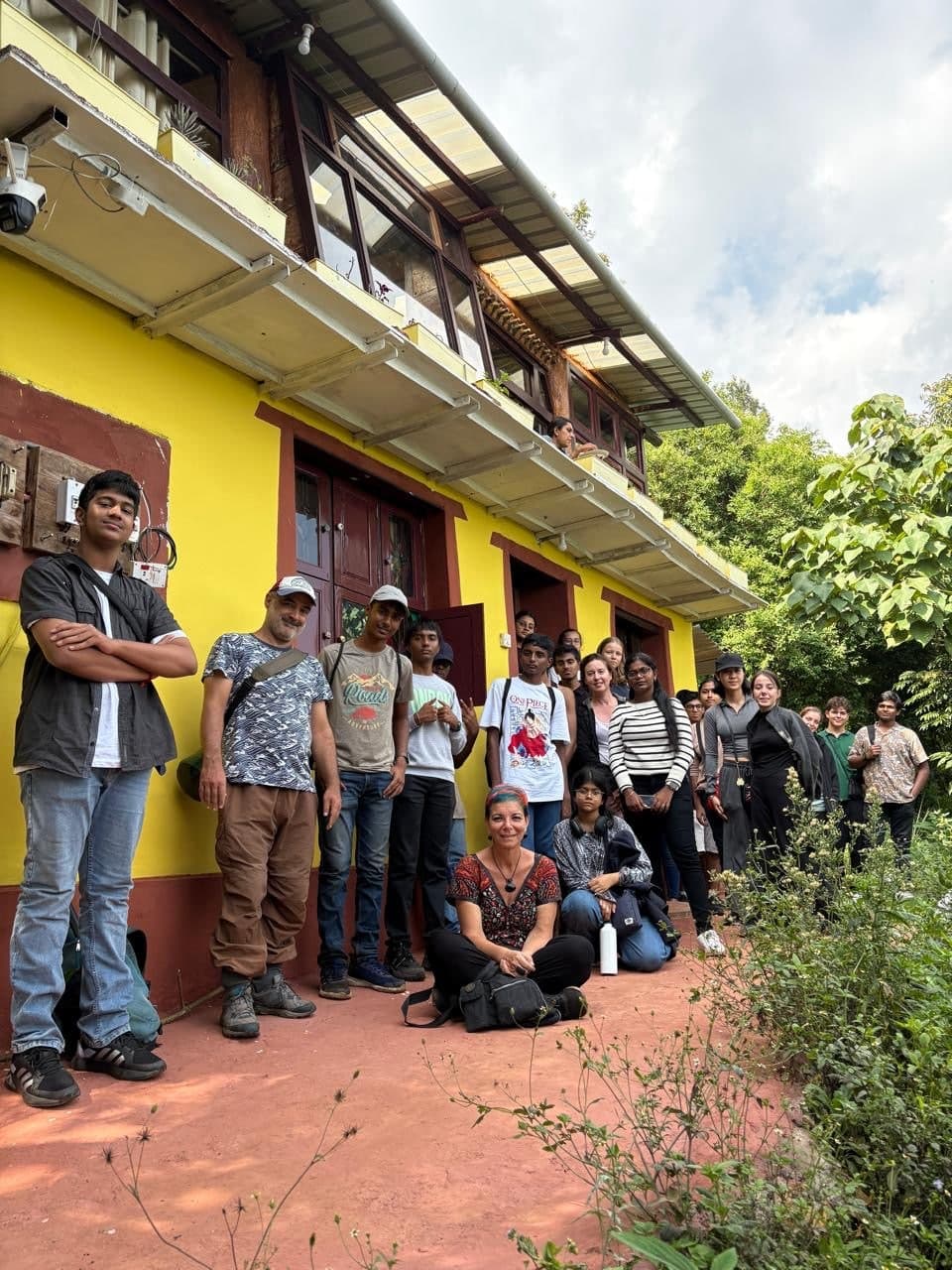

Where you'll stay
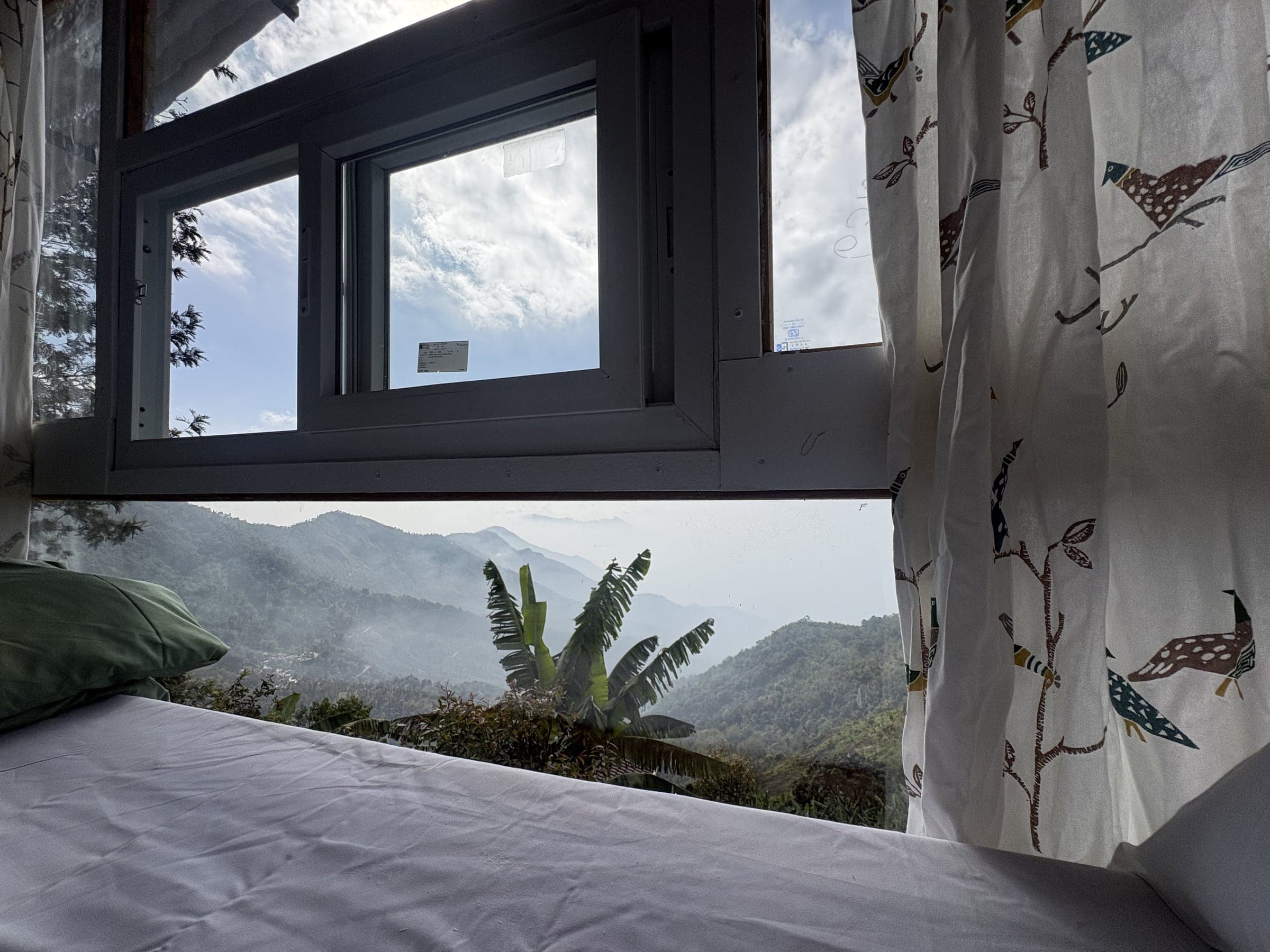
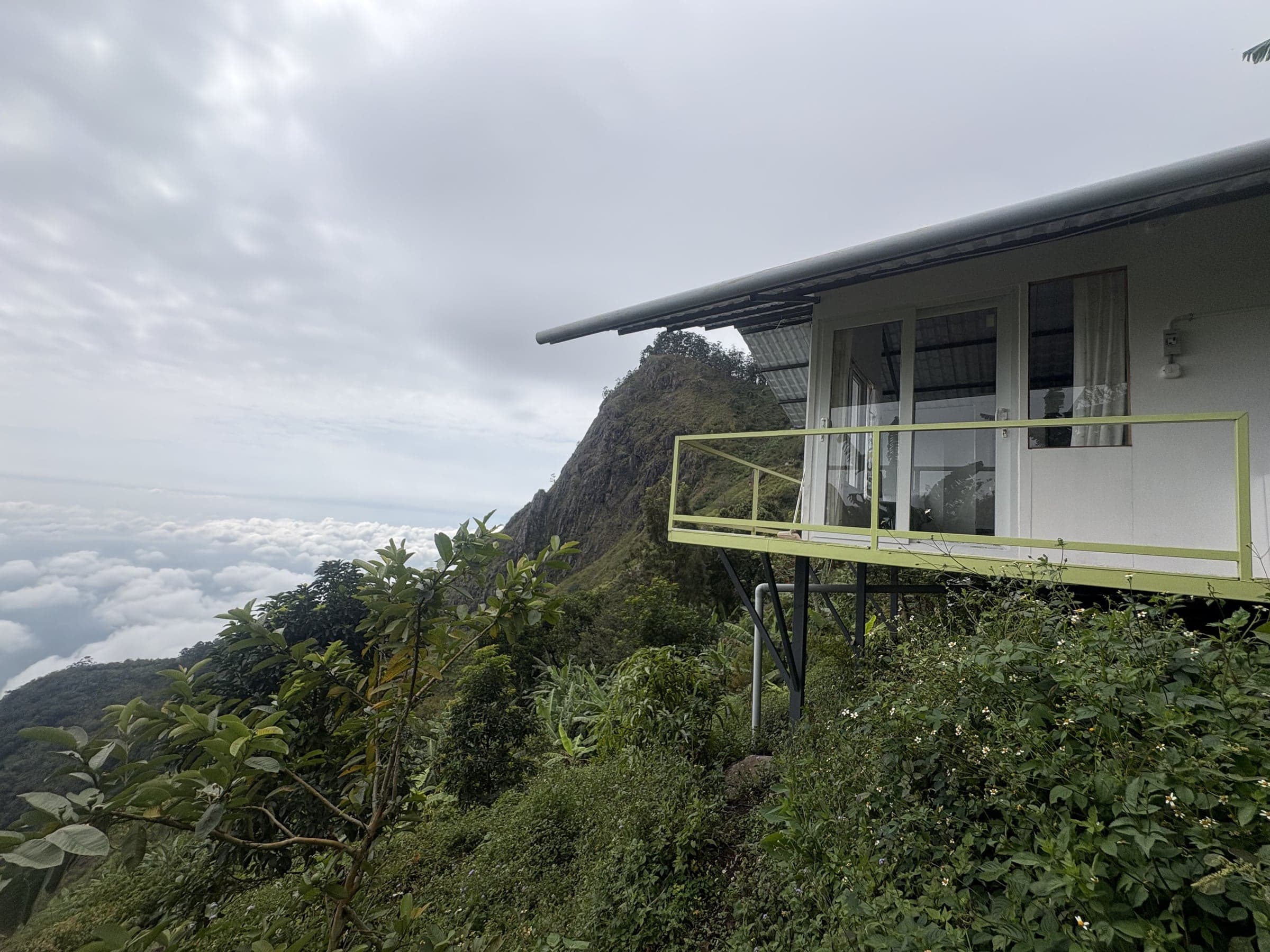
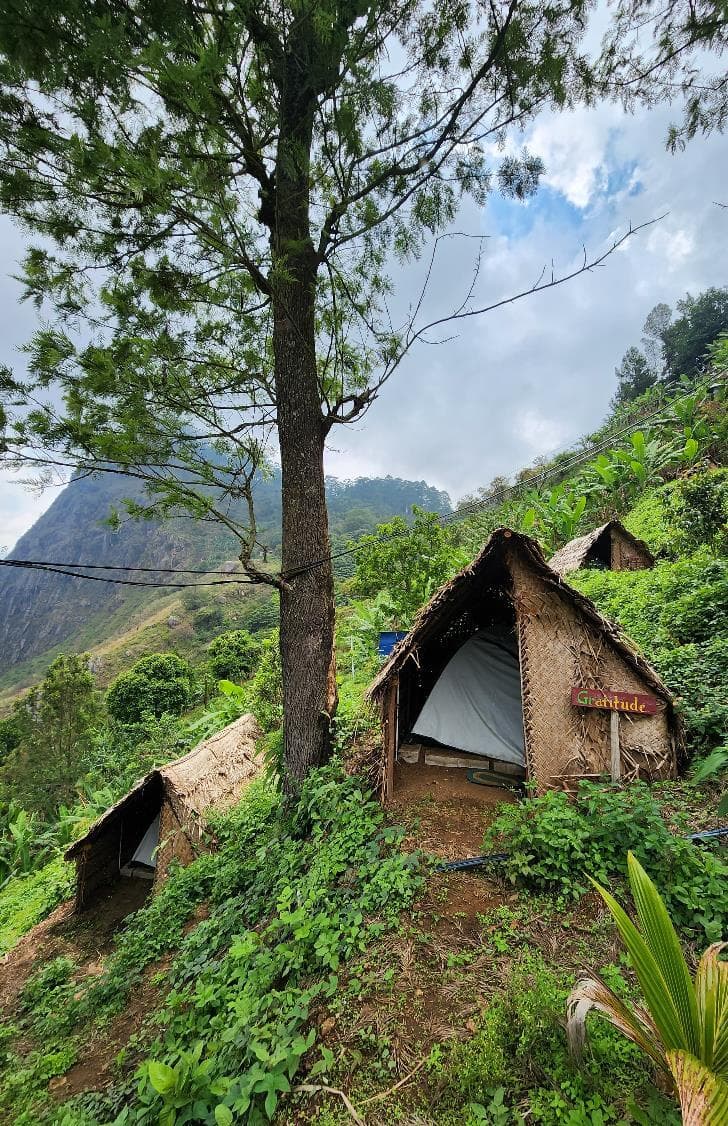
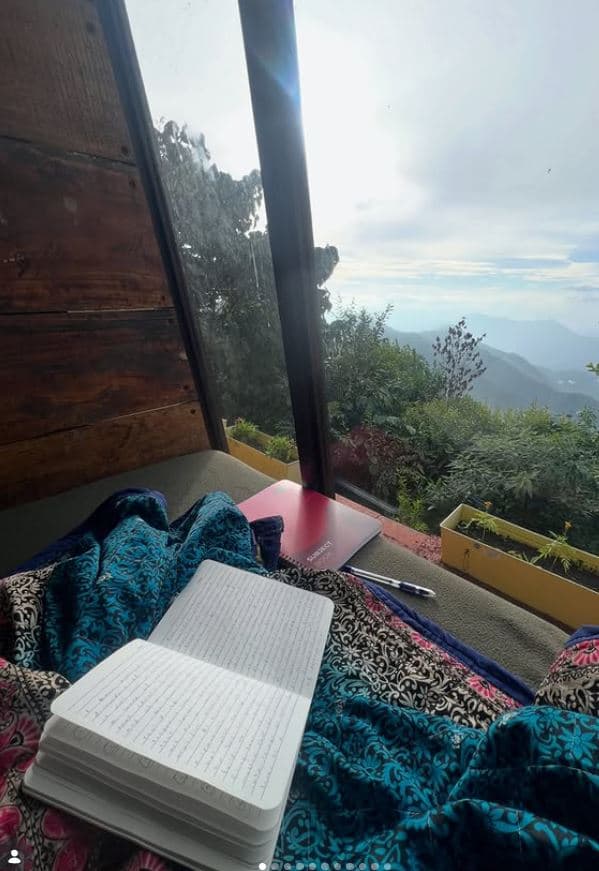
Five places are open to guests, set apart across the slope so each keeps its own quiet and its own view. Hand-built, simple, and full of character: earth walls, salvaged wood, coloured glass, and windows that open straight onto the forest.
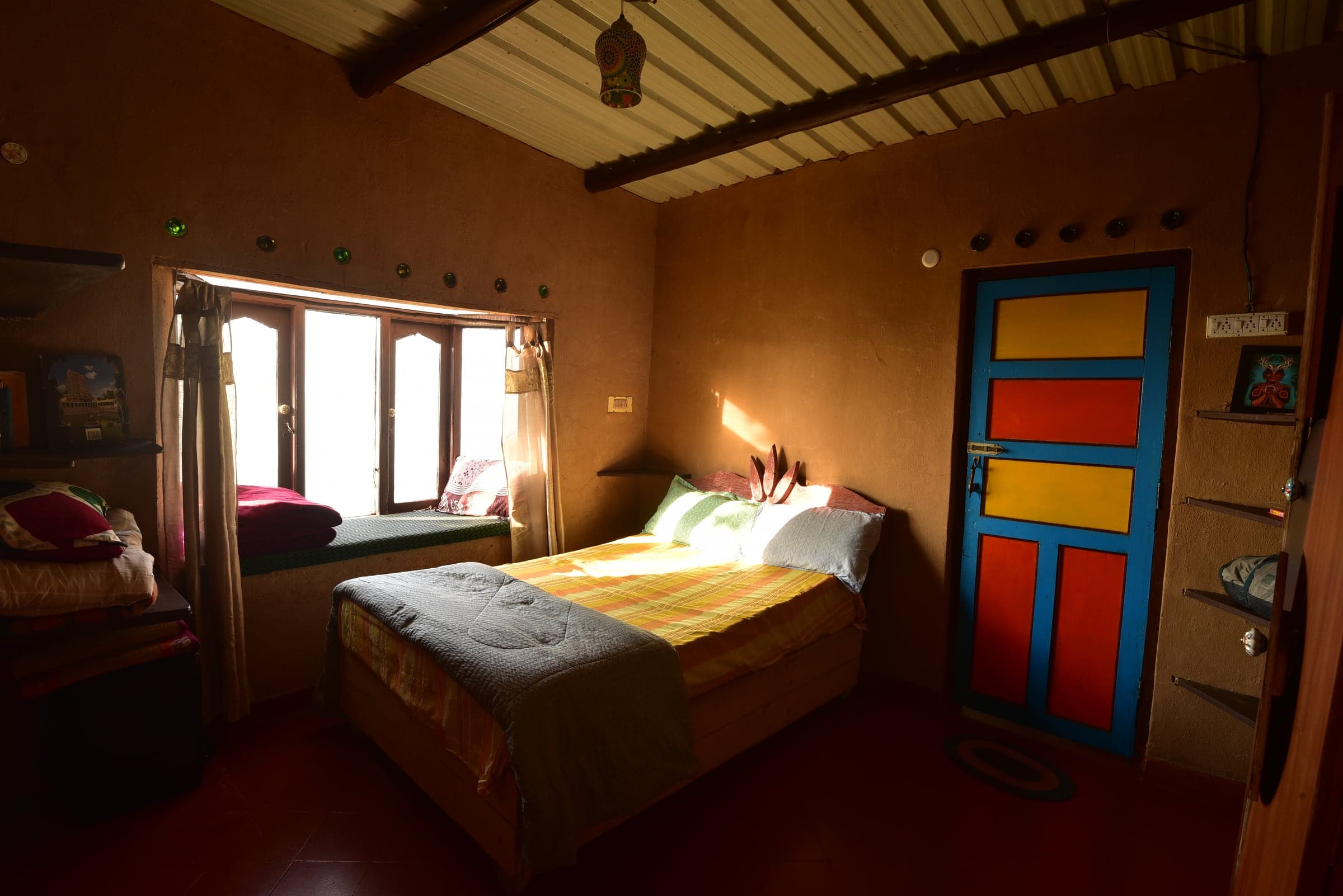
Shanti Home
Earth-walled, warm wood, and a kitchen of its own.
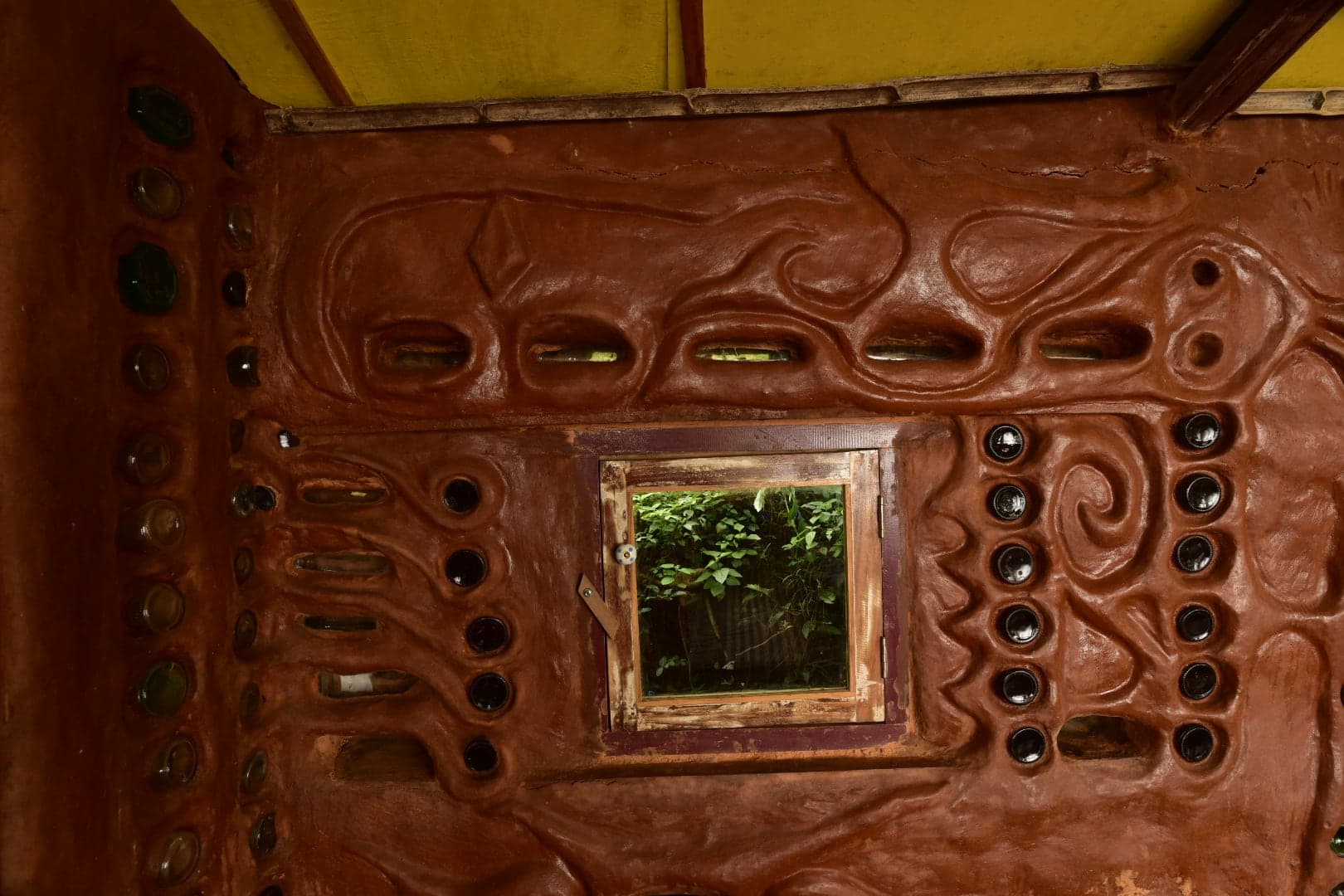
Sujata Home
A larger cob house, coloured glass, its own kitchen.
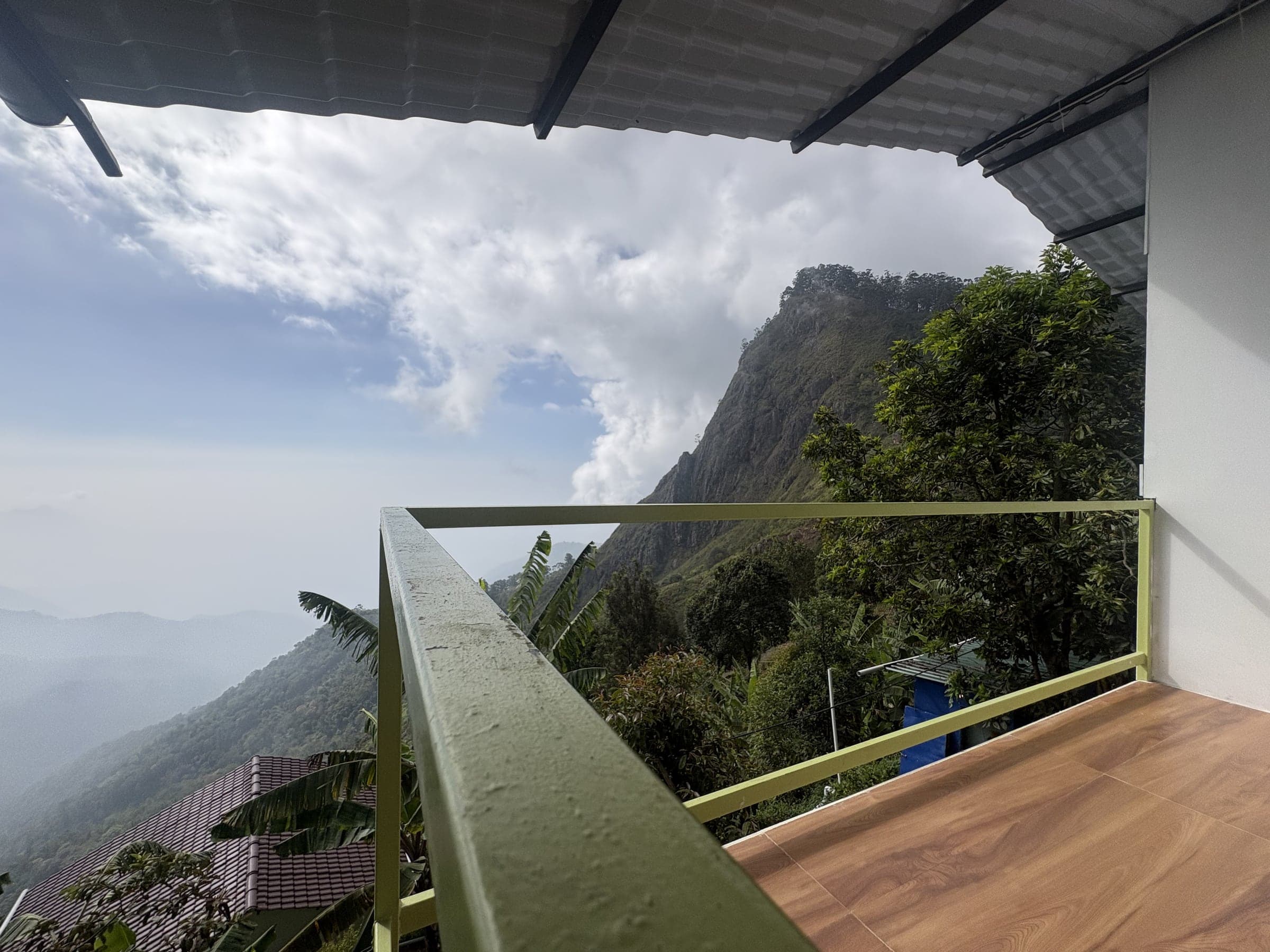
Garden cottages
Three, each ensuite, opening to the valley.
Under canvas
A few thatched tents, open all year.
The two houses, Shanti and Sujata, each have a kitchen, and you are welcome to cook for yourselves. The three garden cottages have no kitchen inside, by design: meals are shared together, and there is a simple, optional camping kitchen a short walk away for anyone who wants to brew tea late or cook outside the usual hours.
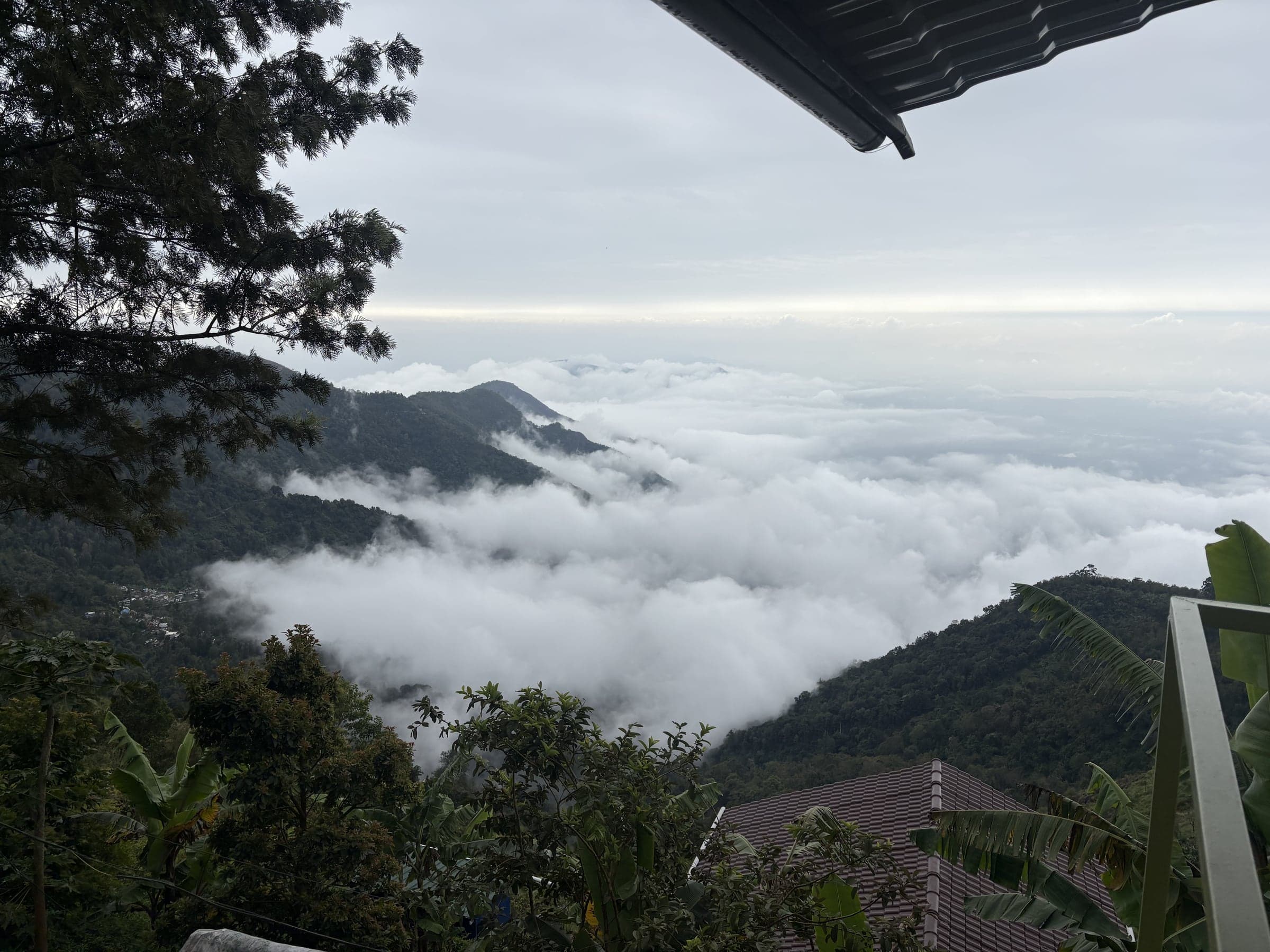
Most mornings, this is the first thing you see.
For those who still have work
Shanti Earth does not ask you to disappear from the world. Many guests come with real work to do: writing, coding, consulting, studying, designing, planning, finishing something long delayed, or finding the courage to begin again.
The middle of the day is intentionally spacious. After morning practice and breakfast, there are hours for your own work, rest, calls, reading, or walking. WiFi is available, though this is still the mountains and not a city office.
There is no glass-walled productivity pod. There is a terrace, a room, a view, a quiet corner, a table near the kitchen, a bench under trees.
You may find the work becomes cleaner here. Not because the internet is faster, but because the mind is less crowded.
No hurry
Two weeks is a beginning. A month or more lets the rhythm do its quiet work.
Enquire about a stay→Optional and gentle
Many people who come here are not simply taking a break. They may be tired from years of pressure. They may be grieving, or changing direction, or recovering from burnout. They may be ending one chapter and beginning another, or just trying to remember what it feels like to be a body in a world that is alive.
Shanti Earth does not promise healing. It offers conditions that can support it: rhythm, quiet, practice, clean food, mountain air, movement, honest company, and a great deal of nature.
For those who are curious, Vinay also offers optional Brown's gas sessions. Some guests find these supportive for vitality and recovery. They are offered gently, charged separately, and without medical claims.
Ask if you would like to know more.
A gentle, honest note
We say this with warmth. Knowing what is not for you is also a kind of clarity.
Before you come
In Nellivarai, outside Prakashpuram, near Kodaikanal, Tamil Nadu, in the Western Ghats. The land sits inside a protected reserve forest, in country that is still genuinely wild.
We help arrange transport by local means from any major airport, railway station, or from Kodaikanal itself. The last stretch is a simple fifteen-minute walk in from where the road ends, so pack light, ideally a backpack you can carry easily.
Plan to reach us before five in the afternoon. This is a reserved-forest area, the light goes quickly, and arriving in daylight makes the walk in a pleasure rather than a puzzle.
Two weeks or more is preferred, long enough for the rhythm to do its quiet work. Longer is often better. Shorter stays may be possible depending on availability.
Two earth-built houses with their own kitchens, Shanti and Sujata, three garden cottages with ensuite bathrooms, and a few thatched tents. Capacity reaches around fifteen, though it is usually kept smaller.
Three vegetarian South Indian meals a day, village-style and seasonal, shared at the communal table. Tea and coffee on the house at breakfast. Tell us of any dietary needs in advance and we will be honest about what we can do.
Clean mountain stream water, good to drink, with filters in each house. Solar-leaning power, so we go gently with both.
The hall is open morning and evening, at 7:30 and 5:30. When a yoga teacher is in residence those hours are taught and guided; when none is, they are for self-practice, or for a walk in the hills if you would rather. Michael is here part of the year. Ask what is likely for your dates and we will be straight with you.
The practice hall at both ends of the day, three daily meals, WiFi, the run of the land and a share in its work, and a guided walk into the surrounding wilderness.
Counselling with Michael when he is in residence, Brown's gas sessions with Vinay, cooking your own in the houses, and farm products to take home: mushroom capsules, calendula salve, neem capsules, jams, podis, and pickles.
Set out in full just below. In short: priced by the room and the length of stay, with the weekly rate easing the longer you settle in. Houses are by enquiry.
No alcohol, drugs, or loud music. The hush after dark is part of what makes the place what it is. Children and pets may be possible with a conversation first.
The land is physically demanding: slopes, steps, uneven paths, and the walk in. Some guests with limited mobility have stayed before. It depends on the person and the season. Ask, and we will be honest.
What a stay costs
Priced by the room and the length of your stay, never by the day. The longer you settle in, the gentler the weekly rate becomes, because this is a place that rewards staying long enough to slow down.
Love · Hope · Joy — for one
₹25,000 the first week, easing to ₹20,000 a week by the month.
One week
₹25,000
Two weeks
₹50,000
Three weeks
₹70,000
One month
₹80,000
Love · Hope · Joy — shared by two
One cottage, both of you: around ₹25,000 each to begin, falling to ₹18,750 each by the month.
One week
₹50,000
Two weeks
₹90,000
Three weeks
₹1,20,000
One month
₹1,50,000
For one · under thatch
₹21,000
a week · flat, any length
The two earth-built houses, each sleeping up to four with a kitchen of its own, are offered to small groups by enquiry, as and when they are free.
All rates in Indian rupees. Every stay includes the practice hall at both ends of the day, three vegetarian meals a day, WiFi, the run of the land and a share in its work, and a guided walk into the surrounding wilderness. Whether those practice hours are guided depends on a teacher being in residence. Counselling with Michael when he is here, Brown's gas sessions, and farm produce to carry home are charged separately.
Tell us your dates and how many of you, and we will confirm what is free.
Take the whole story with you
Forty-odd pages on the land, the days, the people, and how to come and stay. Yours to keep, to read slowly, and to share with whoever you might bring.
Download the brochurePDF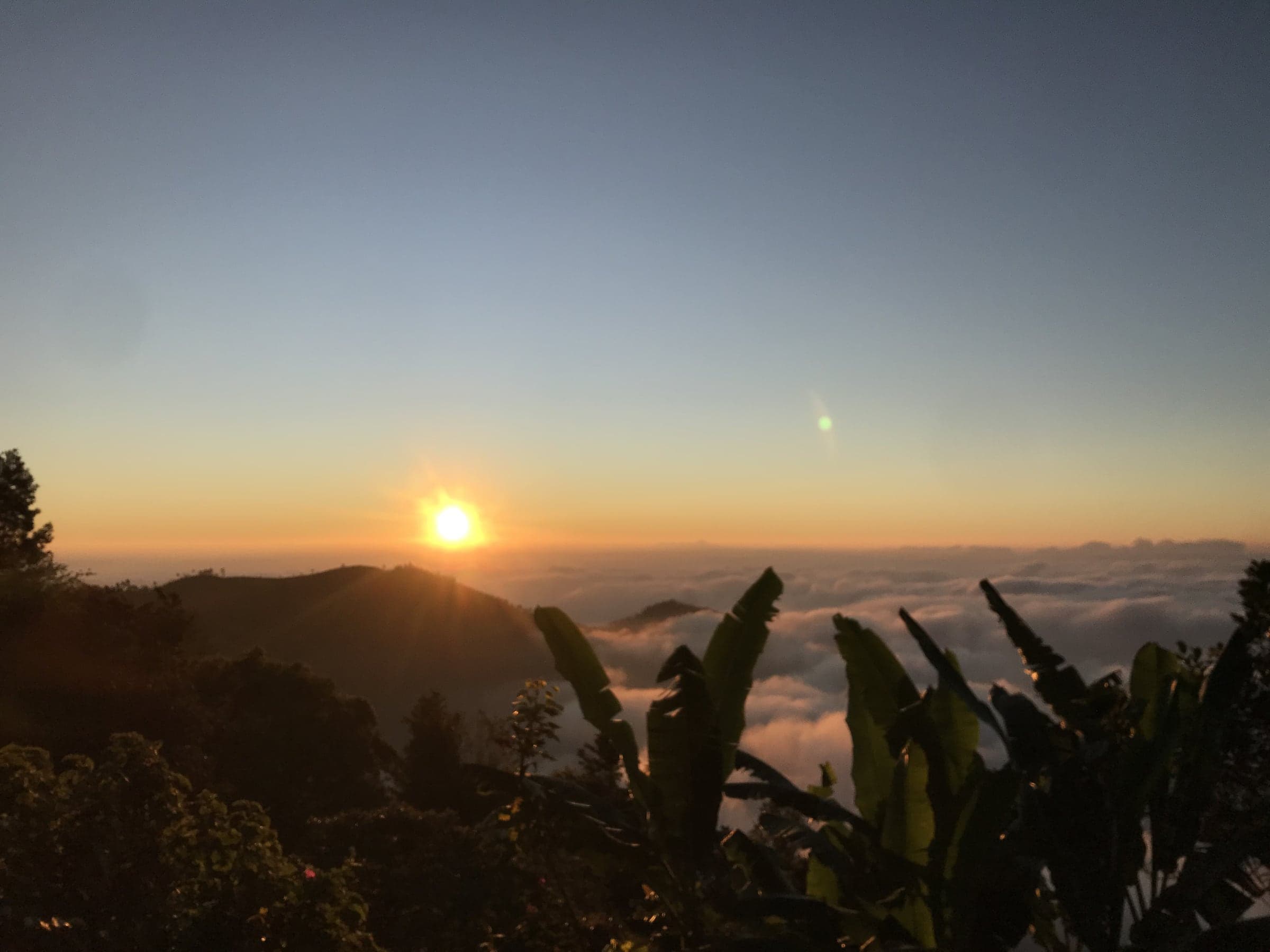
To begin
There is no automated booking funnel here. Tell us who you are, when you might come, and what draws you. Someone will reply personally.
Or simply write to shantifarmsandcamping@gmail.com or message us on WhatsApp